Sunday, September 22, 2013

Evil Villain Lairs, why can nobody ever find them?

When ever I watch a movie and there is some evil villain who has is secret lair, I always wonder how no one knows about it, especially when there are evil henchmen wandering around the place. You see the problem is that it is very difficult to build anything without anyone knowing about it, especially in our day and age. Let me run down a few of the issues with these "Secret Lairs" that the evil villains always have (I suppose this could apply to superheros as well).

You see evil villain lairs look like this (from the first Bond movie Dr. No):


It looks great in a movie but there are several problems here. First, all those people. Do you see all those people? Those are people who have to eat, sleep, go home to visit their families occasionally, go to a bar and drink (let's face it, if you work in an evil lair you aren't going to be Mormon), or do any number of other things that normal people do. I guarantee it that all those people don't live, and don't want to live, in an evil lair. Some of them may even play football (both types) or at least have a fantasy league. In addition to that they have to eat, so that place must have a cafeteria, which means it has a loading dock where all the food comes in.

So the question is, with all these people coming in and out of that evil lair, going home, or on vacation (hey evil minions have to get vacation days too), bringing in food and other supplies, not to mention fuel for their power plant (nuclear power you say? OK where did they get the nuclear fuel? It's not like you can buy that stuff online! Wait, hold on a second...I was wrong, you can. I think I am going to be on some sort of government watch list after my little Googleing session just now. Maybe I shouldn't Google "Where to buy nuclear fuel".) At any rate if you have an evil lair like that then you will have people going in and out of that place. So it is pretty hard to keep it secret.

About a week ago Randall Munroe in his What If blog where he answers random questions was discussing data centers used by Google and others. As part of the discussion he addressed the question of how to find these top secret data centers that Google has where all the Google magic happens. As it turns out that all you have to do is ask taxi drivers and pizza delivery men where they are and they can tell you (because the people that work there tend to order out for pizza alot). So how does this relate to secret lairs? Well in the movies they always portray it as this massive secret lair that nobody on the outside knows about, and the heroes have to go to great lengths to find and then enter the secret lair. I guess Mr. Bond could have just saved himself some trouble and asked the local pizza joint where the secret lair is, and then dressed up as a pizza delivery boy to get in (if Daniel Craig, or whoever is the next Bond, uses this gag in his next Bond film I claim origin and inspiration and will settle for a modest 0.25% of the profits).

The next thing about all those secret lairs is all the stuff they have in them. Do you see all those desks, electrical panels, fancy displays, and stuff? You have to buy all that stuff from somewhere, or at least build it yourself. The thing is you have to buy every nut, bolt, switch, light and relay. So where would you get all those things? Home Depot won't have them all. That's where you go to some company like McMaster-Carr. They have a catalog with all the things you could possibly need for you secret lair. It looks like this:
That's 7 lbs 10.5 oz.
So with that handy catalog you could buy all the things to make your secret lair. But if you put in an order for 100 tons of stuff they will have to deliver it, and that means a shipping address, or at least coordinates where you want your 100 tons of nuts, bolts, pipes, tubes, struts, warning lights, alarms, protective screens, surveillance cameras, etc. Then you have to hire people to install all these things, replace broken ones, then you have to deal with payroll, evil society luncheons, promotions, firings, staff meetings, committee meetings and things like that.

So to make a secret lair you would need the resources of a very large company or an entire nation to build and maintain it, and even then you really can't keep it secret. But they will never put all that in a movie or TV show.

Tuesday, September 10, 2013

Science Problems in the Kolob Theorem

A number of people have asked me to expound upon my first and second reviews of the book The Kolob Theorem (KT). I am hesitant to do this because there are many things in the KT that are obviously incorrect to me, but for those who do not spend a good portion of their time studying and learning astronomy then these errors are not so obvious. Thus it may take a bit of explaining, but if you are interested then read on.

[Again a strong note: I will not speak about the theological implications of the Kolob Theorem. This is only to point out that the book uses some very shaky science to establish its claims. I will again point out that this book was not written by an astronomer. There is a reason why no LDS astronomer has written a book like this, and that is because we recognize that we do not know enough about God, or the universe for a book like this to be written.]

The main text of the KT starts on page 24 (at least in the version that I have access to, linked above). There are a few pages of introductory material before, with some pictures and I will get to those, but my analysis starts on page 25.

I will start near the bottom with the quote by Fred Hoyle. First off, Fred Hoyle was a well known astronomer in his day (he is credited with inventing the phrase "the big bang") but between the publication of his book, Frontiers of Astronomy, in 1955 and the publication of the KT in 2005, our understanding of astronomy has changed more in those 50 years than in the previous 200 years. Yes it really has changed that much. So to rely on an astronomy text book published in 1955 to establish a speculative theory in 2005 automatically places the KT on shaky ground.

Quoting Fred Hoyle Dr. Hilton states:
"The stars in the elliptical galaxies and the stars in the nuclei of the spirals are old stars like the stars in the globular clusters. In contrast, the highly luminous blue giants and super giants are young stars. Young stars are found only in the arms of the spirals."
Our theory would require such a distinction, for the stars in the nucleus must be of a celestial type created first and those of the outer regions of a terrestrial or telestial type and created later.
So the structure that Dr. Hilton sets up for his first corollary, that is central to his entire theory, requires older stars created first to be in the center of galaxy with progressively younger stars as you move out from the center. While it is true that there are many old stars in the center of the galaxy, there are also many old (and in some cases older) stars out in the disk of the galaxy away from the center. The question of where stars form, and how many and how fast they form is still a major area of research. But to illustrate the point here are two pictures of galaxies that are actively forming stars in their center regions.
NGC 3079: The center of the galaxy is an active star forming region. The star formation is actually so strong that it is pushing gas from the center out of the disk of the galaxy. Image credit: NASA and G. Cecil (UNC, Chapel Hill).
M 82: This is actually a composite of images taken from three different telescopes. The green-yellow is from the visible light, the blue is X-rays, the red is infrared. The plane of the galaxy goes from bottom left to top right, but the bright red and blue that is perpendicular to it is hot gas that has been blown out of the galaxy from recent star formation in the center. Image credit: NASA/JPL-Caltech/STScI/CXC/UofA/ESA/AURA/JHU.
As can be seen from the above images there is star formation (and A LOT of it) that happens in the center of the galaxy. Despite what Fred Hoyle states, young stars are not only found in the spiral arms of galaxies. There are plenty of young stars there, but there are even more young stars in the center of galaxies, it's just that they are packed closer together and are mixed with more older stars. As a matter of fact the oldest stars that we can track are found in Globular Clusters (such as M 80), which are most definitely not in the galactic center.

Now on to page 26! (Yes, I have only covered one page.)

Dr. Hilton quotes astronomer Joseph Ashbrook to make the case that there is a dense cluster of old stars in the center of the Milky Way. He sates:
"The core of the Milky Way Galaxy would also possess a tightly packed system of ancient, huge stars in the very heart of the galaxy".
Two things here, he quotes Ashbrook, who may have been a great astronomer (and I can detect nothing wrong with anything Dr. Ashbrook says), but the referenced paper comes from 1968, and the title of the paper refers to Andromeda as a "nebula", not a galaxy. I will get to that in a moment. But the main problem here is that Dr. Hilton is confusing the fact that there is a high amount of stellar mass in the center of the galaxy with there being very massive ("huge") stars in the center of the galaxy. At about this point I probably lost about 98% of my readers and your eyes are glazing over. Stay with me.

So what is the difference between a high amount of stellar mass and a high number of massive stars. Let me explain it like this. Consider two groups of people, groups A and B. In group A the total mass of the group is 20,000 lbs. In group B the total mass is 15,000 lbs. Which group is "bigger". Depends on what you mean by "bigger". It turns out that group A is a group of 300 elementary school students, group B is a NFL football team. Which group is "bigger" now that you know that? Overall the school kids are "more massive" than the football players, but taken individually the football players are 2-8 times more massive than the children. So just because there is a lot of mass in a group of people doesn't mean that the individual people are massive. It means that there could be a lot of them.

The same thing with stars. Just because there is a lot of stellar mass (Dr. Hilton quotes the figure of 10% of the total mass of the galaxy) in the center of the Milky Way, doesn't mean that the individual stars are "huge". As a matter of fact, having "huge" stars would actually be detrimental to his theory, because it turns out that the youngest, most recently formed stars are the most massive, while the oldest, slowest burning stars are the smallest. It seems counterintuitive, but this is precisely the type of mistake that Dr. Hilton makes again and again that undermines his theory. So the "ancient" stars cannot be "huge". In fact the oldest stars would probably be about the same size as our sun, just a lot older.

Next Dr. Hilton moves into a black hole and never makes it out. He gives a definition of a black hole as:
"A black hole is defined as a compact energy source of enormous strength of the order of a billion solar masses".
How can I explain how this definition sounds to a professional astronomer. Assume you had had just finished reading an article about an election in England and read that a new prime minister had been appointed. You turn to me and ask, "What does that mean, 'to be appointed prime minister'?" And I respond, "That is when the Pope comes and crowns the prime minster and puts him on the throne of England." There happens to be a British citizen who over hears this who promptly goes into convulsions and runs screaming from the room, yelling something about "Ignorant Americans". As ridiculous as my statement that a prime minister is "appointed" by being crowned by the Pope is, Dr. Hilton's definition of a black hole is just as ridiculous. It's the kind of thing that keeps astronomy professors up at night fearing that their students may go out into the world and give definitions like that. If you want to know what a black hole is try Wikipedia.

When it comes to black holes there are two types. Stellar black holes that have a mass approximately equal to that of the sun, and super massive black holes that have a mass ranging from 1,000,000 to 10,000,000,000 times the mass of the sun (1e6-1e10 Msun). Stellar mass black holes are all over the place, while super massive black holes are slightly more rare. It is assumed that at the heart of every galaxy, dwarf galaxy, galaxy remnant, compact dwarf galaxy, and ultra compact dwarf galaxy is a super massive black hole. Dr. Hilton later wonders if it is possible that there is a super massive black hole at the center of the Milky Way. Well he doesn't have to wonder since we have already found it! In fact we found it in 1974! (For someone who uses out of date materials he sure missed this one.)

Here is a plot of the orbits of the stars surrounding the Milky Way's central black hole (know as Sagittarius A*):
Source: Wikipedia.
So continuing on, Dr. Hilton tries to tie in the motion of the stars around the central black hole to "rotation" (a key word from the Book of Abraham, he is trying so hard to make the connection, but this isn't going to do it despite his best efforts). He states:
"One measurement of the radial velocities near the nucleus of Galaxy M 84, in the area of Virgo, shows a speed of rotation of 400 kilometers per second at a distance of only 25 light years from the center."
Wow! 400 km/s that sounds fast! For comparison the sun is doing a positively leisurely 220 km/s in its gentle stroll around the Milky Way. But just a second, where did this 400 km/s number come from. These velocities were measured in M84 (also known as NGC 4374) which is about 60 million light years away, i.e. too far to resolve individual stars. So this velocity is more likely a velocity dispersion, that is a difference in velocities averaged over many thousands of stars, this is not the actual velocity of the stars. The max velocity of an individual star is about half of that, so about 200 km/s, which is about how fast the sun is moving. He tries to make something of this much later (chapter 5), but the motions of stars gets very complex, and I'm not going to get into that. Let's just say that you have to distinguish between the motion of individual stars and the motion of the overall galaxy, and sometimes that can be a very tricky thing. Think of the difference between the motion of individual water molecules and the motion of ocean waves. They are not necessarily the same thing.

On page 26 he mentions "Galaxy 87" I assume he means M87, or Messier 87. Messier was the name of an astronomer who spent his time looking at the stars and made a catalog off all the interesting things he saw in his telescope that weren't stars or planets. He made a list 110 "Messier objects" in 1771 that kept interfering with his hunt for comments. Little did he know that he made one of the most important astronomical object catalogs that would define observational astronomy for the next 200 years.

Wow, we are only 3 pages into the text and I already want to quit. I'll mention one more thing.

On page 27 he mentions a star 3000 times the size of the sun. He uses the word size, but fails to understand the fine distinctions he just ran rough shod over. The "3000 times the size of the sun" here obviously refers to physical size, meaning radius, and not mass. There are no stars out there with a mass 3000 times the mass of the sun. Some astrophysicists think that you can get up to 70 or 80 times the mass of the sun, but generally upper cut off value is 40 times the mass of the sun, and those stars are very few and far between. So to have a star that is "3000 times the size of the sun" must refer to physical size, or radius. With stars, it is very tricky to match physical size with mass. They don't always correlate the way you would think. This is another case as I mentioned previously where this is precisely the type of mistake that Dr. Hilton makes again and again that undermines his theory. You see, black holes are the smallest things out there. The vast majority of them are smaller than the earth, and are even smaller than Pluto. It's just that they have a lot of mass in a very small space.

OK to finish off I'll just leave my remaining notes in their raw format. I only got to page 33 (starting on 24) before I gave up and decided that if I went on this post would be way too long.

p. 28 J Ruben Clark quote (concept of galaxy has changed since then, other galaxies were known as extragalactic nebula, other galaxies were still known as extragalactic nebulae until the mid 1950's, and there are even a few references to them in the 1960's. concept of galaxy not pinned down until 1960's.)

p. 29 A galaxy is self gravitating. It's a concept that has it's finer issues.

p. 33 Fred Hoyle again, yes there is dust in the center! Star formation! Lot's of it. Need dust to form stars. No dust, no new stars, it's that simple. Where ever there is dust there are stars forming. Where ever stars are forming there is dust. Dust in the galaxy is a very complex issue. It is no where near as simple as he makes it out to be. There are entire books written on dust in the Interstellar Medium.

Andromeda--How the picture was made--mention false coloring
http://apod.nasa.gov/apod/ap040718.html
http://www.robgendlerastropics.com/M31Page.html
http://www.robgendlerastropics.com/M31Pagegrey.html

Link to false coloring of images.
http://hubblesite.org/gallery/behind_the_pictures/meaning_of_color/

In the end the science issues are so dense and numerous that it is impossible to extract them from the book and from his theory. The only thing to do is to scrap the whole thing and do something else.

References

Joseph Ashbrook, The Nucleus of the Andromeda Nebula, Sky and Telescope, February 1968
Bok and Bok, The Milky Way 5th Edition, Harvard University Press, Cambridge, MA, 1981
Fred Hoyle, Frontiers of Astronomy, New York, Harpers, 1955

Sunday, September 8, 2013

Stories from My Mission: I Enter the MTC

So this story isn't strictly from my mission, but is about the few days right before I entered the Missionary Training Center (MTC).

The actual act of entering the MTC is the ultimate step before you are really committed to being on a mission. Even though the missionaries are set apart usually the day before, or perhaps sooner, and are thus technically missionaries, it is not until they enter the MTC that there is a real feeling of being on a mission. It is an almost indescribable feeling. For all missionaries there are always the last minute things ("Did I pack everything that I need?", "Do I have all my shots?" etc.) and it was the same with me except my last few days were perhaps more hectic than most other missionaries.

At the time I was attending my first semester at BYU and when I submitted my papers to go on a mission I set my availability date at the end of my first semester after finals were done. But when I got my mission call my entry date into the MTC was Dec. 19th, which was a Wednesday, in the middle of finals, and before my listed availability date. Finals week started on Monday of that week and went through Friday. I had 5 classes, with one final scheduled for each day of the week. This meant that my entry into the MTC would conflict with 3 of my 5 finals. Fortunately I was at BYU and all when I explained my predicament to my professors all of them were willing to reschedule my finals.

So from Monday to Wednesday this was what I did.

Monday:

Take geology final first thing in the morning (note: On the syllabus they were quite clear that the final could not be rescheduled for any reason. They were adamant that the final had to be taken at the scheduled time. When I asked my professor about it he was unsure about it (it was a department final) but after asking the department he told me that the final was in the testing center and I could take it any time during finals week. Thus the claim that the final could not be rescheduled for any reason was completely false...grrr).

Second, take mission prep final (This class was with out question the second worst class that I took at BYU. The teacher was a marriage counselor in his day job and thus he kept turning it into a "marriage prep" class rather than mission prep. But he never actually went the full marriage prep route and it just turned into this mish-mash of wobbly warm-ish fuzzy-ish sentimental-ish "take that and stick it in your spiritual pipe and smoke it", hodge-podge of useless goop. I was not a fan, and I think I got a C.)

Third, take my astronomy final from 2-5pm (Dr. Jones who taught the class told me, after I finished the final and he took a moment to chat with me, that I should look him up after my mission and he would get me a job as an astronomy TA. I did and he did manage to find me 2-3 hours a week as an astronomy TA, which may not have been much but that meant that the next semester when I applied for a normal physics TA position I was already technically an employee of the department which meant that I was automatically hired, despite the fact that I had 1 less year of experience than all the other TAs, and it meant that I was the TA for physics majors that were in the same classes that I was in (or higher classes!) but it meant that I got 4 solid years of TA experience under my belt in just about every class, which greatly benefits be now as it has put me in a position where I have 4 more years of experience than all the other graduate students which means I get first pick of TA assignments. Rather than being told what I have to teach I get to choose what I get to teach, and that is nice).

Tuesday:

In the morning I took my biology final, for my first, last and only biology class that I ever took in my entire academic career.

In the afternoon I took my physics 121 final. Looking back I don't think I did as well on it as I should but I wasn't too worried since I calculated it out and determined that in order to drop my grade for the class from an A to an A- I needed to get below a 30%. In order to get a B+ I had to score below 5% on the final, and if I just showed up and wrote my name on the answer sheet I would be guaranteed a B+ in the class. This was of course after having used the class as my guaranteed 3 hours of sleep each week and not turning in more than 3 homework assignments. I always wondered about those "engineers" who failed the class. Wouldn't they rather go into business? But what did I care? They dragged the curve down and gave me the easiest A that I ever got.

I finished my last final at 4 pm. I went directly from there to the BYU bookstore and there I bought the sound track to the movie Oh Brother, Where Art Thou? The movie was quite forgettable, but the music is still some of my favorite. I went out to my car, put in the CD, and drove around for a little under an hour listening to the music. Then I drove over to my brother's apartment, got changed into my new suit, walked up to the JKHB (which technically no longer exists) and at 5 pm I went in for my final interview and got set apart as a missionary.

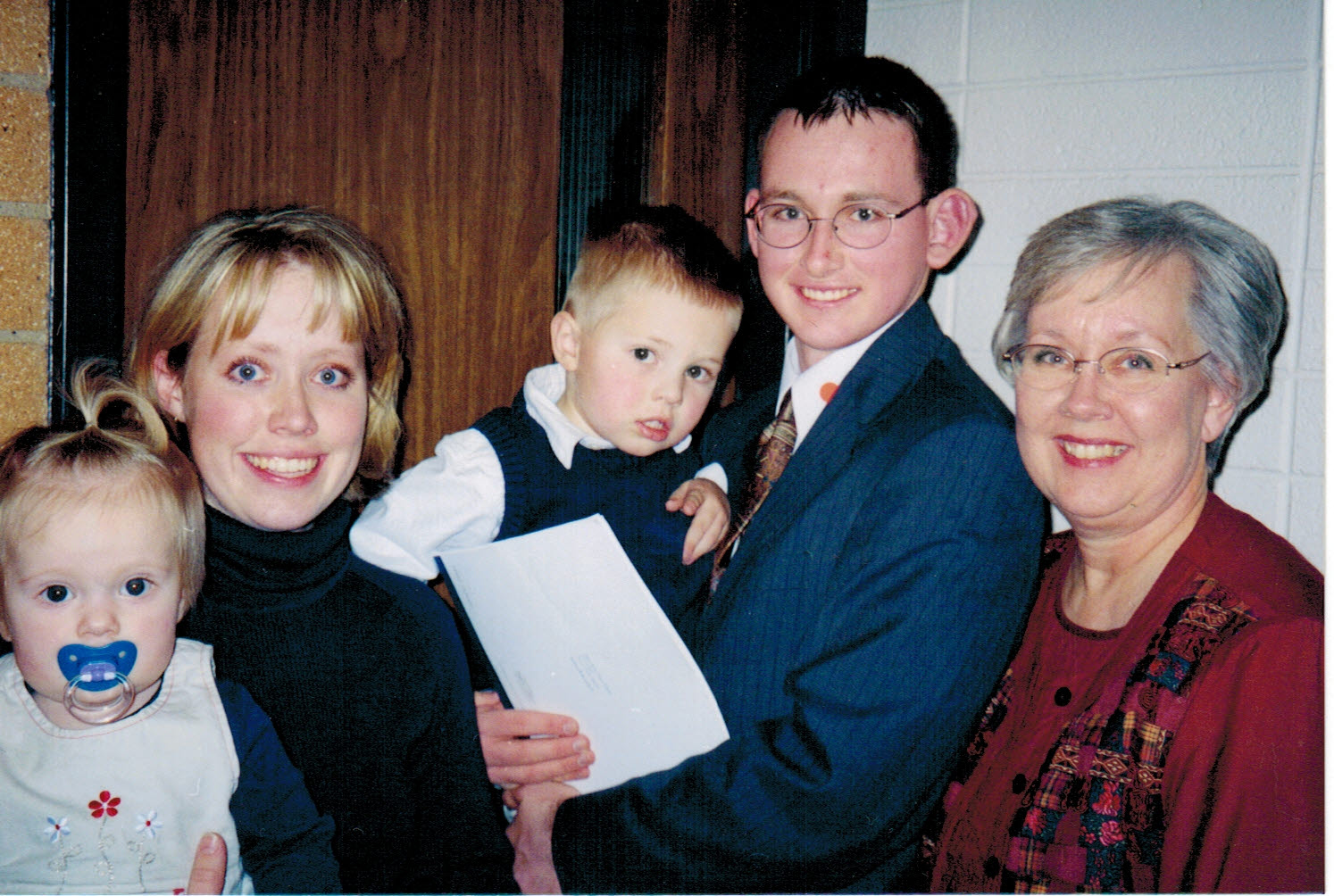
I spent the night at my sister's apartment and then Wednesday morning my parents took me over to BYU one last time to say goodbye to my sister and brother in law and then up to the MTC where another sister came with her two kids to see me off.
Can you tell which one is me? Hint, I don't have a pacifier in my mouth.
At the time I was still in the process of getting all of my required shots. There was one series of shots that required 3 shots spread over several months (a hepatitis vaccine if I remember) and I had the first two but had not gotten the third, so on the first day they went ahead and gave me the third and final dose. It turned out that 6 years later that incredibly minor event saved me a lot of trouble and red tape when I was trying to get into graduate school.

You see, in North Carolina where I am currently going to school, state law requires all students to be vaccinated. As a child I received all the standard vaccines and my mom kept a very accurate record of every shot I ever got. Unfortunately my mom is not a certified nurse, so even though the record was very accurate and complete, UNC would not accept that record. So I was facing the prospect of having to get every single shot again to satisfy the bureaucracy of UNC. All my "official" records were spread all over Arizona in who knows what doctor or government office and it would have been an incredibly hard task to track down all those records. But when I entered the MTC I had received one shot. And that one shot went on my record at the BYU health center, and that was the only nurse certified record that I had access to. So I went there to talk to a nurse and get that one record. While I was there I explained my predicament and asked how I might go about tracking down my record. She looked at the meticulous record that my mom had kept of every shot I ever received, and she thought about it for a second and then offered to enter all that information that my mom had kept over the years into the computer (she was only a certified nurse, and not a nurse practitioner, which meant that technically she was not allowed to do this, but she did it anyway). So she sat there and entered everything into the computer, put it all in my file and printed it out. She signed it (again, I think NC state law required the signature of a nurse practitioner but we were already up to our eye balls in "irregularities" and she didn't want to have to track down and explain to a nurse practitioner what was going on so she just did it).

The only reason why she was able to do that was because I had received that one shot on my first day in the MTC so I was already in the system and she just had to "amend" my file. UNC accepted my new file because it was on official health center letter head and had some sort of signature at the bottom, despite the fact that all the information came from the exact same source that they had strenuously told me was unacceptable.

In so many small ways my experience of entering the MTC was crazy and stressful, but there were the tiny things (me getting to talk to Dr. Jones about getting a job, and me getting a shot) that turned out to be tender mercies much later in my life. There were so many other things about my mission, the people I met, the companions I was with, and the areas I was in, I would have never had those opportunities had I not entered the MTC when I did. Even though from an outside perspective the timing may have been very inconvenient it did in fact make it so that so many things were timed just right during my mission and after my mission so that many opportunities were made available all because of when I went into the MTC.

It kind of made up for the fact that the day I went into the MTC was the same day that the first Lord of the Rings movie came out. But it was OK since I came home and was able to watch the first two in quick succession on DVD and then go see the third one in the theater. Well worth the wait.

Friday, September 6, 2013

Key Differences in the BoM and Isaiah Texts

[This is a cross post from my other blog where I am doing a side-by-side comparison of Isaiah chapters and quotes found in the Book of Mormon.]

After doing a side-by-side comparison of 21 Isaiah chapters in the Book of Mormon I noticed a few interesting things about the variations in the texts. There are many very minor variations between the two texts, but there are also some major variations that quite significantly change the meaning. There are some differences that can obviously be attributed scribal error, on the part of Joseph Smith or Oliver Cowdery (or others, such as the printer) that were never found or corrected. Still there are others that point to a difference of translation, and still others that indicate a fundamentally different text from the ones used in translating the Bible. I will try to give examples of each of these interesting differences below.

I was also impressed with how consistent the two texts are, even though there are obvious differences. After going over the two texts from the Book of Mormon and Bible, I could tell that the text found in the Book of Mormon was not a simple, sloppy, or ignorant attempt at plagiarism of Isaiah found in the KJV Bible. The differences and distinctions are too nuanced, and even when they differ the differences are too unintentional that it would take a world class scholar to produce them, or a very inspired man.

In no particular order here are a few of the interesting differences.

Difference in Translation

Differences in the text are marked in RED.
Variations in the text are marked in ROSE.
Mosiah 14:9
Differences in the text are marked in BLUE.
Variations in the text are marked in GREEN.
Isaiah 53:9

9 And he made his grave with the wicked, and with the rich in his death; because he had done no evil, neither was any deceit in his mouth.

9 And he made his grave with the wicked, and with the rich in his death; because he had done no violence, neither was any deceit in his mouth.

In these verses there is one difference, the word violence is replaced with the word evil. While we may at first assume that this is a difference in the original texts, instead this appears to be a difference in translation. If we compare many different English translations of the same text almost all of them use the word violence, but if we look at a Bible commentary on that passage we find that the same Hebrew word used in that verse is alternately translated as wrong in other verses in the Bible. When Peter quotes the same verse in his first general epistle he uses the word ἀμαρτία which translates, usually, as sin. Also Jesus himself uses a paraphrase of the verse to defend himself as recorded in John 8:46, with the word in question is again translated as sin. So ultimately what we have here is a rather interesting difference in translation. It is a subtle difference but I think that it is still a valid translation of the original concept.

Scribal Error -- The wrong word

2 Nephi 24:19 Isaiah 14:19

19 But thou art cast out of thy grave like an abominable branch, and the remnant of those that are slain, thrust through with a sword, that go down to the stones of the pit; as a carcass trodden under feet.

19 But thou art cast out of thy grave like an abominable branch, and as the raiment of those that are slain, thrust through with a sword, that go down to the stones of the pit; as a carcase trodden under feet.

I was surprised and intrigued when I found this difference. At first I thought that it could be a difference in translation, much like the previous example, but I looked up other Bible translations and it quickly became apparent that the concept bound up in the original text strongly implied raiment and not remnant. In context, and comparing other similar passages from Isaiah, I am inclined to think that this difference is due to a scribal error. Considering the fact that the two words are very similar when spoken aloud (at least with your standard American accent), and considering the fact that Joseph Smith was dictating the text, it would be very easy for this error to happen. Also because the word remnant makes sense in context this would not be an error that would be easily found and corrected without a review of the original text.

Additional Text -- Slight changes in meaning

2 Nephi 24:2 Isaiah 14:2

2 And the people shall take them and bring them to their place; yea, from far unto the ends of the earth; and they shall return to their lands of promise. And the house of Israel shall possess them, and the land of the Lord shall be for servants and handmaids; and they shall take them captives unto whom they were captives; and they shall rule over their oppressors.

2 And the people shall take them, and bring them to their place: and the house of Israel shall possess them in the land of the Lord for servants and handmaids: and they shall take them captives, whose captives they were; and they shall rule over their oppressors.

In several places there are whole phrases or sentences added that expound on the meaning of the original text. In the verses above there is an additional sentence that adds additional information about what is meant by the verse. There are a few other seemingly minor differences later on in the verse but when they are considered in conjunction with the earlier addition, the subtle changes made to the content is consistent and insightful.

The Missing Words -- Italicized text

2 Nephi 15:28-29 Isaiah 5:28-29

28 Whose arrows shall be sharp, and all their bows bent, and their horses’ hoofs shall be counted like flint, and their wheels like a whirlwind, their roaring like a lion.

28 Whose arrows are sharp, and all their bows bent, their horses’ hoofs shall be counted like flint, and their wheels like a whirlwind:

29 They shall roar like young lions; yea, they shall roar, and lay hold of the prey, and shall carry away safe, and none shall deliver.

29 Their roaring shall be like a lion, they shall roar like young lions: yea, they shall roar, and lay hold of the prey, and shall carry it away safe, and none shall deliver it.

After doing a few chapters I decided that I needed to keep track of the italicized text in the Bible. For those who don't know, in the KJV of the Bible there are many words that are in italics. These are words that do not appear in the original Greek or Hebrew, but must be added to make it grammatically correct in English. For any one who has learned a foreign language this is something obvious about translation. Sometimes certain words (pronouns, participles, adverbs etc.) are not needed in another language, but are needed in English. After a while I noticed that a number, but not all, of the italicized words in the KJV were either missing or different in the Book of Mormon. This would indicate a slightly more literal translation was used for the Book of Mormon. That was a particularly remarkable realization and changed the way I viewed the basic text of the Book of Mormon.

Also there were a few cases where a phrase that appeared in a previous verse was moved to the next verse in the corresponding chapter and verses. The two above verses are an example of that.

Joseph Smith's Commentary

1 Nephi 20:1 Isaiah 48:1

1 Hearken and hear this, O house of Jacob, who are called by the name of Israel, and are come forth out of the waters of Judah, or out of the waters of baptism, who swear by the name of the Lord, and make mention of the God of Israel, yet they swear not in truth nor in righteousness.

1 Hear ye this, O house of Jacob, which are called by the name of Israel, and are come forth out of the waters of Judah, which swear by the name of the Lord, and make mention of the God of Israel, but not in truth, nor in righteousness.

The very first chapter that I did, the very first verse, turned out to be one of the most interesting in terms of providing insight into not only how the translation process worked, but also Joseph Smith's idea of what it meant to "translate" something. If Joseph Smith had ever had the opportunity to attend a real university, and if he had taken a class on Biblical Hebrew then he surely would have failed the class and would have driven the professor to the point of insanity. Joseph Smith's idea of "translation" was to say or write down whatever he thought it meant, not what it actually said.

Fortunately Joseph's translation of the Book of Mormon was more of a revelatory process and not an academic process, which is what most people think of when they hear the word "translation". Most people think that Joseph sat there and translated, in an academic sense, the etchings on the gold plates, which would have required him to actually learn Reformed Egyptian. But from the many accounts of people who witnessed the translation process, the translation was more of an inspired revelation that utilized the resources of Joseph's mind to formulate the text into English. It was by all measures quite remarkable.

So why this little rant of mine? Because of the phrase "or out of the waters of baptism". That phrase does not appear in original manuscript, nor in the printer's manuscript, nor in the 1830 edition of the Book of Mormon, but it does appear in the 1840 edition of the Book of Mormon. What that phrase appears to be is a "prophetic commentary" by Joseph Smith. It is something that he apparently had no problem adding to the text as he considered it his job to "translate" and to expound scripture, but it is something that would make academics working on a translation tear out their hair and curl up in a ball in the corner of the room and cry for hours on end. It is a major indication that Joseph Smith did not understand translation in the same way that you and I view translation. Upon finding out that he would change the text like that some people would, and do, criticize him for improperly changing the meaning, but as far as we can tell this is the only instance of "prophetic commentary" by Joseph Smith in the Book of Mormon. The rest of the text seems to be as it was on the gold plates.

Conclusion

To be honest I was never wild about Isaiah like some people are in the Church. It never crossed my mind to take the class Writings of Isaiah at BYU. I did, and still do, read Isaiah in my personal scripture study. I think that by far my favorite chapter in all of scripture is 3 Nephi 22, which is also Isaiah 54, so it cannot be said that I dislike Isaiah, it's just that never felt an intense desire to take a class devoted to Isaiah, or to write a book about him. So it may be a little odd that I spent, and will still spend so much time on this project. Still, I think I learned more about Joseph Smith and how he translated the Book of Mormon than I did about Isaiah by doing this. It definitely changed the way I view the actual text found in the Book of Mormon and it gave me a greater appreciation of how real, and in some cases, how literal the text is. I think the translation is a very good one and will stand the test of time.

Wednesday, August 28, 2013

Was Lehi a Samaritan?

A few days ago I read an article entitled "Who Were the Samaritans?" on Interpreter that I thought was very interesting. It gave a basic outline of the Samaritans from their perspective and not from the perspective of the Jews and early Christians. The entire article is worth the read, but I will sum up the important points that are relevant to my current post.

I remember being taught in Seminary, Sunday School, Institute classes and in Religion classes at BYU that the Samaritans were descended from the people brought in by the Assyrians after they conquered the northern kingdom. What I had been taught was that the Assyrians carried away the remaining Israelites and brought in other conquered people and told them to worship the god of the land (meaning the Hebrew god). Thus the Samaritans, although they followed the Mosaic Law, were considered illegitimate and not true Israelites and thus were excluded from all official worship, rights, and privileges. They were therefore looked down upon by the time Jesus began his ministry. This negative view formed the basis of the parable of the Good Samaritan, and also Jesus teaching the woman at the well.

It's a nice neat picture and seems to be supported by history, and the Bible, until you hear the Samaritans' side of the story.

The Samaritans consider themselves to be pure descendants from Israel (yes I used the proper verb tense, the Samaritans are still around), and have a slightly different version of what happened. The split between the northern and southern kingdoms goes back to the time of the prophet Samuel and the high priest Eli, and the high priest Uzzi. ("huh? what? who in the world is Uzzi?", well that's the point, the Jews don't like to talk about him, so that is why you never heard his story.) If you read the Bible (that is the collection of books, prophecies, and histories kept by the Jews, emphasis on the Jew part) then you can read the story of how the high priest Eli wasn't such a great guy because he didn't do anything about his sons wickedness. God had to speak to the young boy Samuel at night to get him to tell Eli that he (Eli) had been rejected as high priest. Thus began the prophetic career of Samuel who would go on to be prophet and anoint Saul as king of Israel.

The part that you never hear, but is told by the Samaritans is that Eli actually wasn't the legitimate high priest, Uzzi was. But because Uzzi was only a young boy he could not act as high priest, but Eli wanted to take over the post. There was an intense debate regarding who should be the high priest. The tribe of Judah supported the usurper Eli while the other tribes supported Uzzi as the legitimate successor of Aaron. This started the general rift between the tribe of Judah and all the other tribes (as a side note, it would appear that this was the basis of the north-south split that would not break out until after king Solomon died). So each kingdom traced their priesthood authority back to what they considered to be the legitimate source, and each kept their own history, prophecies and revelations, but almost all of the history kept by the northern kingdom was lost when the Assyrians destroyed the capital Samaria. Thus the only surviving histories that we have are those kept by the Jews that may have been edited for political reasons (i.e. "We aren't going to tell their side of the story." and "We won't include the writings of these prophets in our scriptures because they are "Northern" prophets.").

So where does Lehi fit into all of this? If you recall, after Lehi's sons returned from Jerusalem with the brass plates, Lehi (or at least Nephi, according to how he told the story many years later) was surprised to learn that he was descended from Joseph. Apparently this was significant enough that Lehi decided to name his a son after Joseph. So why was this significant? If you recall from what was previously explained, in the social, political, and historical context that Lehi (and Nephi) came from this meant that they learned, perhaps for the first time, that they were not Jews. To them this may have been a real paradigm changer since they realized that they were actually part of the alternate history of the northern kingdom. If you carefully review all instances where Nephi refers to the Jews, you will find that Nephi never refers to himself or his descendants as Jews. They are referred to as a remnant of the house of Israel, but never Jews. In fact if you reread the verses where Nephi references the Jews you may get a sense that he considers them to be a separate people from him, his ancestors, and his descendants.

We learn later that Lehi was actually descended from Manasseh, which would put him, historically, as a member of the northern kingdom. It could be that Lehi's family fled Samaria (or some other place up north) when the northern kingdom was overthrown by the Assyrians, or they could have come later, we will never be sure. It seems that by the time it got to Lehi it may have been a little unclear which tribe he was descended from. But in any event, by being descended from Manasseh would mean that Lehi was technically part of the people who were considered to be, or would later be called Samaritans. We are not sure when the people who were the remnant of the northern kingdom were labeled as Samaritans, and based on the information provided in the article that I linked to at the very beginning the intense animosity between the Jews and Samaritans may not have come to fruition until after the Jews' return from their Babylonian captivity. Thus the kind of animosity that we find in the New Testament most likely grew in the 600 years that separated Lehi from New Testament times.

So why else may all this have been significant? I find it interesting that God was so particular that Lehi send his sons back to Jerusalem to get the records from Laban. Were there not any other scriptures lying about Jerusalem that were easier to get? Or perhaps they had to go get that particular set which, because it is implied that Lehi and Laban were somehow related, were the scriptures kept by the Samaritans living in Jerusalem, and thus had a slightly different set of prophetic writings, including Neum, Zenos, Zenock and Ezias (for wild speculations as to who Ezias was read my ramblings here, perhaps my conclusions in that post are extremely interesting considering the current topic). Something interesting to consider.

So in the end, was Lehi a Samaritan? Well, in the sense that we tend to think of Samaritans, no he wasn't. But he was a descendant of Manasseh, which would make him one of  the people of northern kingdom. Those people would eventually become the Samaritans that we know from the New Testament, and that are still around today. So strictly speaking we can't call Lehi a Samaritan, but based on the writings of Nephi, it would seem that we can't call them Jews either, and that I think is something to think about.

Thursday, August 8, 2013

Stories from My Mission: "You need to repent!"

I won't say where this story happened so that I can preserve the identity of those involved.

In my mission there was a senior couple, the Elder and Sister Wilcox, who were serving as missionaries. Shortly after they arrived Elder Wilcox was asked to serve as a counselor in the Mission Presidency. This meant that he would travel to the various District Conferences (like Stake Conferences) where the Mission President was unable to attend (we had about 15 districts in our mission). It was during one of these conferences that I was asked to accompany Elder Wilcox in an interview. He was not very proficient in Spanish and needed someone to translate for him.

The man Elder Wilcox was going to interview was someone who had been a member for many years but recently had been disfellowshipped. The purpose of the interview was to sort out the problems and to see if the man could return to full fellowship in the Church.

The interview began as a simple fact finding procedure, "So what is your story? When you were disfellowshipped by the District Presidency what were the reasons they told you? What have you done about it?" etc. According to this man's version of events, he was disfellowshipped for having a general disagreement with the local church leaders. Basically what it came down to was they, the church leaders, didn't like him, and he didn't like them so they told him that he couldn't use his priesthood and that he couldn't hold a calling.

Since I was only there as an interpreter and a facilitator I didn't have any say in the matter, and I will refrain from making any statement about who was right other than what Elder Wilcox ultimately decided.

To back up his case he said that he was a good man who did many good things. He said that he took care of his children, even those who were not strictly his children. He mentioned that before he met his wife she had worked as a prostitute and had three children from that. When he married her he took those children as his own and raised them accordingly. He was even sealed to them in the temple (which in this part of Argentina, to have a family like that who had been to the temple was very rare). He used this and other examples to make the case that he was a good man who tried to live within the covenants and commandments.

He then made the case that the District President was not so holy (they were neighbors). He related an experience where he said that he saw the District President beat one of his children in a rather harsh manner. He said that his being disfellowshipped was simply a result of the District President projecting his own sins and failing on him.

After listening to all of this, and after I made sure that Elder Wilcox had understood everything that had been said, Elder Wilcox paused, bowed his head as if in prayer or contemplation for a moment. Then he raised his head, looked the man in the eye and in flawless Spanish told the man, "You need to repent! The problem here is that you have not forgiven your wife! That is what you need to repent of!"

The man was rather taken back, because up until now this had all been about the dispute between him and the District President, but the thought that the real problem was one between this man and his wife had never occurred to him.

Elder Wilcox continued on and explained, "You have never forgiven your wife for the things she did before she met you. You said that she worked as a prostitute before she met you, and you said that you married her anyway. You said that you brought her to church, along with her children who were born of her prostitution, and that this made you a good man. She has been baptized, she has gone to the temple and wears the holy garment."

"The Lord has forgiven her her sins and remembers them no more. But you still remember them and you still think of her being defined by her past sins. You should not have mentioned them or even brought them up. You will not be forgiven until you humble yourself and never speak of her past sins any more. She has given them up, and the Lord has accepted her repentance. Now you need to accept her change of life."

When the man heard this he was left almost speechless. He said that no one had ever told him that. He didn't realize that his perception of his wife was having such a profound impact on him and how he viewed others. In a moment his entire demeanor changed. Whereas before he seemed to be inflated with pride and wounded pride as having been disfellowshipped, be was now immensely humble and contrite. It was as if in a moment all his pride was stripped away from him. He promised that he would forgive his wife, and that he would never again mention her past sins. The issue between him and the District President was not even mentioned again. Due to the force of the Spirit that accompanied Elder Wilcox's admonition he had experienced a sudden and dramatic change of heart.

Monday, August 5, 2013

Stories from My Mission: The Butcher Fist Bump

I thought I should share a some what shorter and lighter story after my last two.

In my first area of Bella Vista there were many things that I had to learn about Argentina. One of the minor things that I had to pick up was how butchers greeted people. Because they work with meat their hands are usually covered in meat juices, and everyone else's hands are well, covered in who knows what. So butchers don't shake hands. What they do instead is extend their hand in a fist are you are expected to grab their forearm just above the wrist and "shake" their hand.

The first time I met a butcher and he extended his closed fist to me I had no idea what I was supposed to do. So I did the only thing I could think of, I gave him a fist bump. My companion, Elder Tenny, busted up laughing and the butcher was very confused, and I had no idea what was going on. Elder Tenny thankfully took the time to explain to the butcher what I had done and to explain to me the proper way of "shaking hands" with a butcher. I still think my way is better.