I think that the events of recent weeks, especially in Libya, prove the wisdom and truthfulness of these words. While many people, countries and nations have looked to kings, or strong autocratic rulers, as a solution to their current problems. Unfortunately the end result is usually more hardships and trouble for the people. In the end it never turns out to be a solution.
16Now I say unto you, that because all men are not just it is not expedient that ye should have a aking or kings to rule over you.17For behold, how much ainiquity doth one bwicked king cause to be committed, yea, and what great destruction!21And behold, now I say unto you, ye cannot dethrone an iniquitous aking save it be through much contention, and the shedding of much blood.22For behold, he has his afriends in iniquity, and he keepeth his guards about him; and he teareth up the laws of those who have reigned in righteousness before him; and he trampleth under his feet the commandments of God;23And he enacteth laws, and sendeth them forth among his people, yea, laws after the manner of his own wickedness; and whosoever doth not obey his laws he acauseth to be destroyed; and whosoever doth rebel against him he will send his armies against them to war, and if he can he will destroy them; and thus an unrighteous bking doth pervert the ways of all righteousness. (Mosiah 29:16-17,21-23)
Sunday, February 27, 2011
"Ye cannot dethrone an iniquitous king save it be through much contention"
In light of the current events happening in the Arab world I thought that this short passage from The Book of Mormon was particularly applicable.


Monday, February 14, 2011
The Original Second K.T. Post
[Update 4/17/11: Because most traffic about The Kolob Theorem was still being directed to my old post, I decided to replace my original post with this one, because this review is perhaps more informative than the original.]
Previously I had written a post entitled The Problem with "The Kolob Theorem", and in revisiting the topic I thought that I should expound on why I think The Kolob Theorem to be problematic. This post is intended to replace my previous review of The Kolob Theorem, but I will leave the other post up for anyone who cares to read it, but I will say that I wrote it in one of my less charitable moments. This post will hopefully be a little less harsh, but more instructive of why The Kolob Theorem presents a problem in LDS theology. For reference, I have recently been reading the book Science, Religion, and Mormon Cosmology by Erich Robert Paul, which has prompted me to recast my critique of The Kolob Theorem in a different light.
The first time I encountered The Kolob Theorem I was at my wife's grandparents house. Someone had loaned my wife's grandmother the book and I saw it sitting on a table and was intrigued by the title and wanted to know what it was about. I only took a quick glance through the book but it was enough to make my skin crawl. There were in fact two reasons for my seemingly severe negative reaction to the book. The first was that there were critical scientific errors in the book that effectively invalidated the whole argument, and the second was that I realized that most people would be unaware of these critical errors and thereby base their understanding of scripture on a foundation of incorrect science.
What made this second reason so problematic was that as an astronomer I would most likely be asked about it (and I was) and I would have to very carefully and politely explain that while the science was extremely off base the religious aspect of the book was not. In other words, I realized that whenever I would be asked about this book I would be faced with the dilemma of having to state quite clearly that the book was wrong, and do so without destroying someone's faith in the scriptures or causing the person to also reject all of science in the process. Essentially the dilemma is that on the one hand I want to emphasize the problems and misconceptions that went into the theorem, without causing people to react and go to the other extreme of rejecting everything that went into the theorem including both the science in general and the specifics of the revelations. This dilemma is much more difficult to deal with than people realize, and it also comes up more frequently than most people are aware of. Perhaps I am just a little more sensitive to this problem due to my being an astronomer, and therefore I become the local "go-to guy" to resolve these issues and thus I have to deal with things like this on a semi-frequent basis.
The Kolob Theorem is part of group of theological writings that are called natural theology. Strictly speaking, natural theology denotes a fundamental approach to theology as opposed to a specific theology. Thus natural theology is not confined to any one religion or church. The main trust of natural theology is to verify one's religion using arguments from the prevailing scientific theories and observations of the day. It is in effect an attempt to argue that one's religion is true based on the latest and greatest theories in science. This is problematic because if the latest and greatest theories are shown to be wrong then that automatically calls into question the theology and religion of the natural theologian.
Dr. Hilton's book is a prime example of the process, and problems, of natural theology. Starting with some basic astronomy, he moves on to make a theological argument about where God lives and where the three degrees of glory are located. As Erich Robert Paul pointed out in his book on Mormon cosmology, Joseph Smith never attempted to reconcile the knowledge of astronomy from the Book of Abraham, or the three degrees of glory with any contemporary astronomical observations. Thus Dr. Hilton is attempting what Joseph Smith never attempted. This may be very commendable and courageous, or more likely it may prove to be premature and problematic. To consider why this is problematic we need to consider other failed attempts at natural theology.
In the middle ages there was a type of world map called a T-O map that was common in the religious books at the time.
The purpose of the T-O map is to show the general layout of the world and how it reflects Christian theology. These maps were made to show how certain Christian doctrines are symbolically part of the world. The world is laid out in such a way that the cross of Christ is evident, with Jerusalem at the center (the cross being formed by the Mediterranean Sea, the Nile and the Don rivers). There was more symbolism in the O of the ocean surrounding the land (the complete, eternal circle of God, and water from the water and the blood). While the map may have been useful to teach certain religious doctrines, it is not very accurate when compared to an actual map of the world.
The way Dr. Hilton attempts to show the location and structure of the three degrees of glory only makes sense when using a very simplified map of the galaxy. Much in the same way that the T-O map of the world is only theologically useful when you assume a very simplified structure to the world. While the T-O map may be theologically instructive, it is rather useless as an actual map that may be used to get from point A to point B.
The end result is that the theological argument gets based on a very simplified, and very inaccurate, map of the world. The same happens with The Kolob Theorem. Dr. Hilton uses an excessively over simplified "map" of a galaxy to make a theological argument. The end effect of the theorem is to place the veracity of the revealed word, the scriptures, on a specific scientific theory or observation. To a natural theologian this is the desired result, but this has the unintended result of making revelation depend on something that may not be true, or that may change as our understanding changes. This is precisely the problem that plagues The Kolob Theorem.
For example, Dr. Hilton includes a quote from a famous astronomer, Fred Hoyle, to back up part of his theorem. The quote, found on page 25 of the book, comes from 1955 and at the time it expressed the current understanding of how stars formed in galaxies. But our understanding of astronomy has changed since then and parts of the view as expressed in Fred Hoyle's quote no longer reflects our understanding of star formation.
By basing part of his argument on a specific scientific theory, or insight, Dr. Hilton does himself a disservice because he places the interpretation and veracity of revealed scripture on something that can and will most likely change as we gain greater understanding of how the universe works. He is in effect setting himself up, and setting up his faith and by extension, the faith of others, to be disproven when the next largest telescope gets built and we find out more about the universe. That is, for me, a very problematic result to his theory. I would not want members of the Church to base their faith, testimony, or understanding of the scriptures on something that is already demonstratively false and will become more so as we gain new insights into the universe though our astronomical observations.
So in his attempt to make the latest and greatest astronomical observations into something "faith promoting", Dr. Hilton enters the realm of natural theology which "opens up a whole new can of worms" which may be more troublesome than Dr. Hilton realizes. Because the current astronomical observations are just that, current, they will grow old and become yesterday's observations and then last century's observations, and all the theories that they produced will have changed. This does not mean that we should reject all astronomical observations and untrue, unimportant or insignificant, but rather we should resist the temptation to base our faith on something that has proven throughout history to change. There should be a better foundation to our faith than the latest and greatest theories of science.
Also as a final note, I realize that many people are impressed with this book mostly because they have never considered the implications of what is written in the Book of Abraham and in the Doctrine and Covenants. Many of the positive comments posted on goodreads.com about the book are from people that say that the book "opened their eyes" or "made them think about their religion in a different way" and how it made "the plan of salvation more real". While I can't argue with their own personal feelings (and if the book did prompt them to investigate the scriptures more, then good I'm all for that), I do wish to temper their enthusiasm with the realization that to base our theology, faith and religion on something like The Kolob Theorem will ultimately result in a challenge to our faith and will not be "faith promoting" in the end. The truth of God is more amazing than anything that you will find in The Kolob Theorem.
Previously I had written a post entitled The Problem with "The Kolob Theorem", and in revisiting the topic I thought that I should expound on why I think The Kolob Theorem to be problematic. This post is intended to replace my previous review of The Kolob Theorem, but I will leave the other post up for anyone who cares to read it, but I will say that I wrote it in one of my less charitable moments. This post will hopefully be a little less harsh, but more instructive of why The Kolob Theorem presents a problem in LDS theology. For reference, I have recently been reading the book Science, Religion, and Mormon Cosmology by Erich Robert Paul, which has prompted me to recast my critique of The Kolob Theorem in a different light.
The first time I encountered The Kolob Theorem I was at my wife's grandparents house. Someone had loaned my wife's grandmother the book and I saw it sitting on a table and was intrigued by the title and wanted to know what it was about. I only took a quick glance through the book but it was enough to make my skin crawl. There were in fact two reasons for my seemingly severe negative reaction to the book. The first was that there were critical scientific errors in the book that effectively invalidated the whole argument, and the second was that I realized that most people would be unaware of these critical errors and thereby base their understanding of scripture on a foundation of incorrect science.
What made this second reason so problematic was that as an astronomer I would most likely be asked about it (and I was) and I would have to very carefully and politely explain that while the science was extremely off base the religious aspect of the book was not. In other words, I realized that whenever I would be asked about this book I would be faced with the dilemma of having to state quite clearly that the book was wrong, and do so without destroying someone's faith in the scriptures or causing the person to also reject all of science in the process. Essentially the dilemma is that on the one hand I want to emphasize the problems and misconceptions that went into the theorem, without causing people to react and go to the other extreme of rejecting everything that went into the theorem including both the science in general and the specifics of the revelations. This dilemma is much more difficult to deal with than people realize, and it also comes up more frequently than most people are aware of. Perhaps I am just a little more sensitive to this problem due to my being an astronomer, and therefore I become the local "go-to guy" to resolve these issues and thus I have to deal with things like this on a semi-frequent basis.
The Kolob Theorem is part of group of theological writings that are called natural theology. Strictly speaking, natural theology denotes a fundamental approach to theology as opposed to a specific theology. Thus natural theology is not confined to any one religion or church. The main trust of natural theology is to verify one's religion using arguments from the prevailing scientific theories and observations of the day. It is in effect an attempt to argue that one's religion is true based on the latest and greatest theories in science. This is problematic because if the latest and greatest theories are shown to be wrong then that automatically calls into question the theology and religion of the natural theologian.
Dr. Hilton's book is a prime example of the process, and problems, of natural theology. Starting with some basic astronomy, he moves on to make a theological argument about where God lives and where the three degrees of glory are located. As Erich Robert Paul pointed out in his book on Mormon cosmology, Joseph Smith never attempted to reconcile the knowledge of astronomy from the Book of Abraham, or the three degrees of glory with any contemporary astronomical observations. Thus Dr. Hilton is attempting what Joseph Smith never attempted. This may be very commendable and courageous, or more likely it may prove to be premature and problematic. To consider why this is problematic we need to consider other failed attempts at natural theology.
In the middle ages there was a type of world map called a T-O map that was common in the religious books at the time.
 |
| A reconstruction of a T-O map. Image from Wikipedia. Usually the map is represented with Asia (east) on top. |
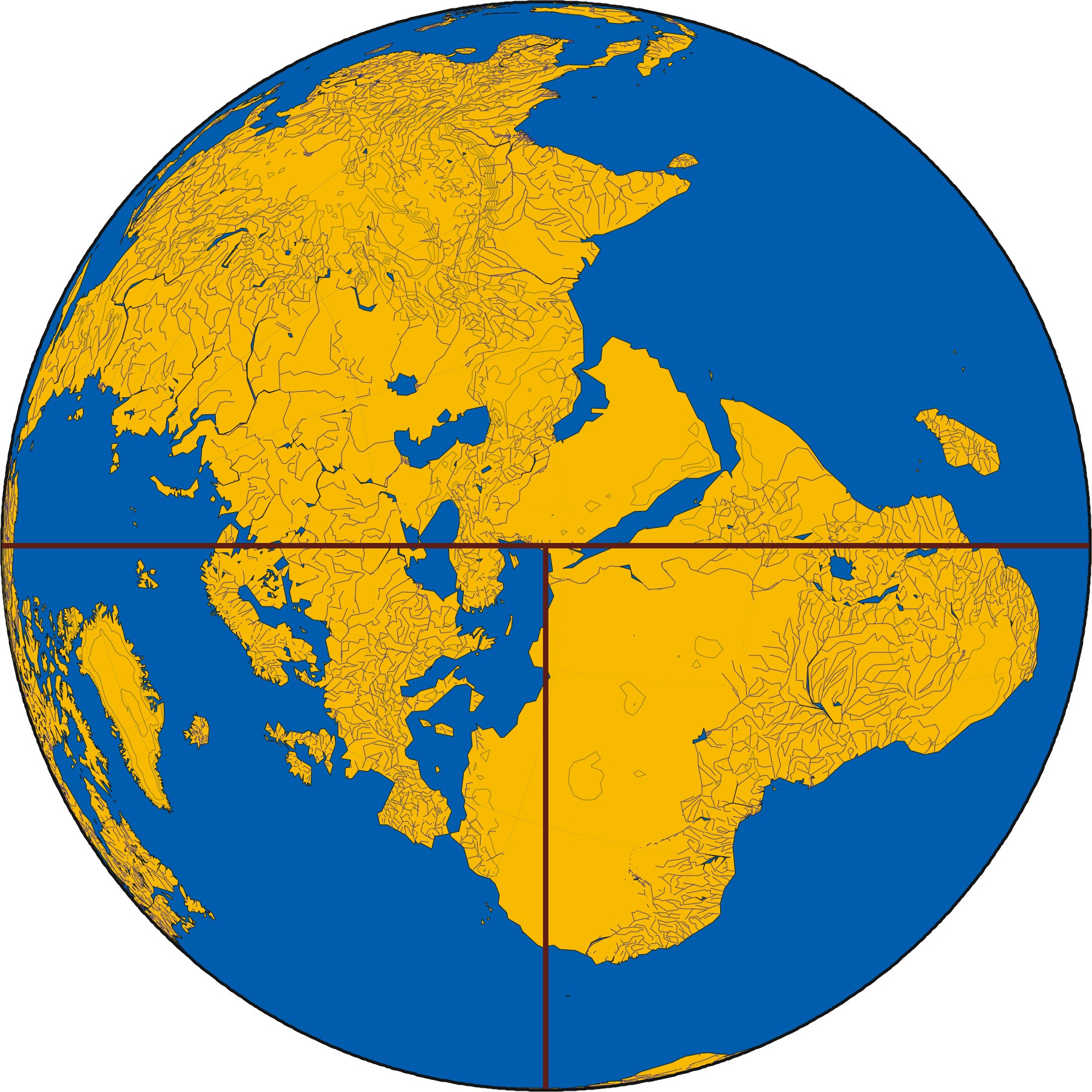 |
| The T-O map superimposed on a modern map. Image from Wikipedia. |
The end result is that the theological argument gets based on a very simplified, and very inaccurate, map of the world. The same happens with The Kolob Theorem. Dr. Hilton uses an excessively over simplified "map" of a galaxy to make a theological argument. The end effect of the theorem is to place the veracity of the revealed word, the scriptures, on a specific scientific theory or observation. To a natural theologian this is the desired result, but this has the unintended result of making revelation depend on something that may not be true, or that may change as our understanding changes. This is precisely the problem that plagues The Kolob Theorem.
For example, Dr. Hilton includes a quote from a famous astronomer, Fred Hoyle, to back up part of his theorem. The quote, found on page 25 of the book, comes from 1955 and at the time it expressed the current understanding of how stars formed in galaxies. But our understanding of astronomy has changed since then and parts of the view as expressed in Fred Hoyle's quote no longer reflects our understanding of star formation.
By basing part of his argument on a specific scientific theory, or insight, Dr. Hilton does himself a disservice because he places the interpretation and veracity of revealed scripture on something that can and will most likely change as we gain greater understanding of how the universe works. He is in effect setting himself up, and setting up his faith and by extension, the faith of others, to be disproven when the next largest telescope gets built and we find out more about the universe. That is, for me, a very problematic result to his theory. I would not want members of the Church to base their faith, testimony, or understanding of the scriptures on something that is already demonstratively false and will become more so as we gain new insights into the universe though our astronomical observations.
So in his attempt to make the latest and greatest astronomical observations into something "faith promoting", Dr. Hilton enters the realm of natural theology which "opens up a whole new can of worms" which may be more troublesome than Dr. Hilton realizes. Because the current astronomical observations are just that, current, they will grow old and become yesterday's observations and then last century's observations, and all the theories that they produced will have changed. This does not mean that we should reject all astronomical observations and untrue, unimportant or insignificant, but rather we should resist the temptation to base our faith on something that has proven throughout history to change. There should be a better foundation to our faith than the latest and greatest theories of science.
Also as a final note, I realize that many people are impressed with this book mostly because they have never considered the implications of what is written in the Book of Abraham and in the Doctrine and Covenants. Many of the positive comments posted on goodreads.com about the book are from people that say that the book "opened their eyes" or "made them think about their religion in a different way" and how it made "the plan of salvation more real". While I can't argue with their own personal feelings (and if the book did prompt them to investigate the scriptures more, then good I'm all for that), I do wish to temper their enthusiasm with the realization that to base our theology, faith and religion on something like The Kolob Theorem will ultimately result in a challenge to our faith and will not be "faith promoting" in the end. The truth of God is more amazing than anything that you will find in The Kolob Theorem.
Sunday, February 13, 2011
I don't know where Kolob is, so stop asking.
I will just apologize up front, this post will be a rant.
In short, I don't know where Kolob is, so stop asking. Because I am an astronomer it seems like about once a month I get asked, "So, have you found Kolob yet?" Mostly when I get that question I respond with a simple, "No." But sometimes I am tempted to respond with much more, but usually that would involve technical explanations that would put my listeners to sleep long before I get to the punch line and the effect would be totally wasted. But for those who are tempted to ask their local LDS astronomer (like me) if they have "found Kolob yet" let me explain just what it is they are asking.
First, all we know about Kolob is this:
So to ask me "Have you found Kolob yet?" is like asking me, "Have you found that one thing that is next to that other thing?" Of course my answer will be "No." As soon as we know what that one thing is that is next to that other thing, and what that other thing is then I will know what I am looking for and then I might just be able to begin to look for it. Until then, don't ask.
In short, I don't know where Kolob is, so stop asking. Because I am an astronomer it seems like about once a month I get asked, "So, have you found Kolob yet?" Mostly when I get that question I respond with a simple, "No." But sometimes I am tempted to respond with much more, but usually that would involve technical explanations that would put my listeners to sleep long before I get to the punch line and the effect would be totally wasted. But for those who are tempted to ask their local LDS astronomer (like me) if they have "found Kolob yet" let me explain just what it is they are asking.
First, all we know about Kolob is this:
2 And I saw the stars, that they were very great, and that one of them was nearest unto the throne of God; and there were many great ones which were near unto it;This comes from the Book of Abraham Chapter 3, translated by Joseph Smith from ancient Egyptian papyri. So unless we talk to the original author (Abraham), the translator (Joseph Smith) or the revelator (God), or we happen to have access to a set of Urim and Thummin there isn't anything we can add to what we read in the Book of Abraham. That's it, that's all we have. So to "look for Kolob" we would be looking for a star (no idea what type) "nigh unto the throne of God" which we have little idea what that is either. So to "find Kolob" we are looking for a star of unknown type, somewhere in the Universe (a very, very, very, very, very, very, very, very, very, very big universe, emphasis on the big), that is somewhere close to "the throne of God" which, unless you have actually seen it, we have no idea what it looks like. Thus we are looking for a star (unknown type) next to something that we don't know what it is.
3 And the Lord said unto me: These are the governing ones; and the name of the great one is Kolob, because it is near unto me, for I am the Lord thy God: I have set this one to govern all those which belong to the same order as that upon which thou standest.
4 And the Lord said unto me, by the Urim and Thummim, that Kolob was after the manner of the Lord, according to its times and seasons in the revolutions thereof; that one revolution was a day unto the Lord, after his manner of reckoning, it being one thousand years according to the time appointed unto that whereon thou standest. This is the reckoning of the Lord’s time, according to the reckoning of Kolob.
5 And the Lord said unto me: The planet which is the lesser light, lesser than that which is to rule the day, even the night, is above or greater than that upon which thou standest in point of reckoning, for it moveth in order more slow; this is in order because it standeth above the earth upon which thou standest, therefore the reckoning of its time is not so many as to its number of days, and of months, and of years.
6 And the Lord said unto me: Now, Abraham, these two facts exist, behold thine eyes see it; it is given unto thee to know the times of reckoning, and the set time, yea, the set time of the earth upon which thou standest, and the set time of the greater light which is set to rule the day, and the set time of the lesser light which is set to rule the night.
7 Now the set time of the lesser light is a longer time as to its reckoning than the reckoning of the time of the earth upon which thou standest.
8 And where these two facts exist, there shall be another fact above them, that is, there shall be another planet whose reckoning of time shall be longer still;
9 And thus there shall be the reckoning of the time of one planet above another, until thou come nigh unto Kolob, which Kolob is after the reckoning of the Lord’s time; which Kolob is set nigh unto the throne of God, to govern all those planets which belong to the same order as that upon which thou standest.
10 And it is given unto thee to know the set time of all the stars that are set to give light, until thou come near unto the throne of God.
11 Thus I, Abraham, talked with the Lord, face to face, as one man talketh with another; and he told me of the works which his hands had made;
12 And he said unto me: My son, my son (and his hand was stretched out), behold I will show you all these. And he put his hand upon mine eyes, and I saw those things which his hands had made, which were many; and they multiplied before mine eyes, and I could not see the end thereof.
13 And he said unto me: This is Shinehah, which is the sun. And he said unto me: Kokob, which is star. And he said unto me: Olea, which is the moon. And he said unto me: Kokaubeam, which signifies stars, or all the great lights, which were in the firmament of heaven.
14 And it was in the night time when the Lord spake these words unto me: I will multiply thee, and thy seed after thee, like unto these; and if thou canst count the number of sands, so shall be the number of thy seeds.
15 And the Lord said unto me: Abraham, I show these things unto thee before ye go into Egypt, that ye may declare all these words.
16 If two things exist, and there be one above the other, there shall be greater things above them; therefore Kolob is the greatest of all the Kokaubeam that thou hast seen, because it is nearest unto me.
So to ask me "Have you found Kolob yet?" is like asking me, "Have you found that one thing that is next to that other thing?" Of course my answer will be "No." As soon as we know what that one thing is that is next to that other thing, and what that other thing is then I will know what I am looking for and then I might just be able to begin to look for it. Until then, don't ask.
Sunday, January 30, 2011
Is God Omnipotent?
The question of God's omnipotence frequently comes up in religious discussions, yet there is rarely any agreement or consensus on the matter. Most Christians will agree that God is omnipotent (also omniscient and omnipresent, collectively known as "the three omni's") but what that actually means differs greatly from church to church and from theologian to theologian. Even among Mormons there is some debate as to what it means for God to be omnipotent (though decidedly less than other churches). Some take the standard Protestant/Catholic approach complete with ontological arguments, while others take a more experiential approach to God which makes a discussion of ontological arguments, and by extension, a discussion of the three omni's irrelevant. But the question remains, is God omnipotent?
When confronted with this question I could ask, "What do you mean by omnipotent?" but that rarely gets anywhere. So the other day I was thinking about it and I came up with a way of responding to that question. When I am asked, "Is God omnipotent?" I will respond with another question, "Is the earth a sphere?" The answer to that question is "'Yes.'" but it is a qualified "yes". The earth is very spherical, but to say that it is a perfect mathematical sphere of uniform density is to destroy the reality that is the earth. But to say that the earth is not a sphere is to ignore the obvious fact that it is a sphere, even if it is not a perfect, mathematical sphere. For all practical purposes (air travel, satellites, ocean navigation, astronomy, warfare, cartography, farming etc.) the earth (as a whole) can be treated as a perfect sphere, but to always think of the earth as a perfect sphere would ignore the immense complexity, wonder, and beauty that is the earth. So no, the earth is not a simple mathematical sphere, but that is what makes the earth so wonderful.
So is God omnipotent? Only in as much as the earth is a sphere.
When confronted with this question I could ask, "What do you mean by omnipotent?" but that rarely gets anywhere. So the other day I was thinking about it and I came up with a way of responding to that question. When I am asked, "Is God omnipotent?" I will respond with another question, "Is the earth a sphere?" The answer to that question is "'Yes.'" but it is a qualified "yes". The earth is very spherical, but to say that it is a perfect mathematical sphere of uniform density is to destroy the reality that is the earth. But to say that the earth is not a sphere is to ignore the obvious fact that it is a sphere, even if it is not a perfect, mathematical sphere. For all practical purposes (air travel, satellites, ocean navigation, astronomy, warfare, cartography, farming etc.) the earth (as a whole) can be treated as a perfect sphere, but to always think of the earth as a perfect sphere would ignore the immense complexity, wonder, and beauty that is the earth. So no, the earth is not a simple mathematical sphere, but that is what makes the earth so wonderful.
So is God omnipotent? Only in as much as the earth is a sphere.
Saturday, January 22, 2011
Book Review: Inventing the Flat Earth by Jeffrey Burton Russell
I have known about the flat earth error for some time but I have never actually read a book or even a scholarly article detailing where the myth started and how it entered our popular culture. Then I came across Inventing the Flat Earth by Dr. Russell, and I was impressed with how quickly he presented the argument and dealt with the issue. The book is a very short read (77 pages, not including end notes, 30 pages, "selected" bibliography, 7 pages, and an index) and can be finished in an afternoon (or over a few days if you only take it a few pages at a time). It covers the topic very well and gives you a good sense of how, and why, the flat earth error started. But because of its length, it is only good as a starting point if you want to get deeper into the subject. For those who only want to learn about the flat earth error and how it started then this is the book for you.
First, the book is about the flat earth error also referred to as the Myth of the Flat Earth, not to be confused with the error of the flat earth. Simply put, the flat earth error is the idea that people in the middle ages thought that the earth was flat and not spherical. As Dr. Russell demonstrates, ever since the Greeks proved the sphericity of the earth the scholarly consensus has been that the earth was spherical. There was some debate as to the size, whether or not there was land on the opposite side and whether or not that land was inhabited. But there was never any serious question as to whether or not the earth was a sphere.
Dr. Russell explains that the only opposition to Columbus was not from people who thought the earth was flat, but from other scholars who thought that the earth was bigger than Columbus calculated it to be (which it was). If Columbus's calculations were correct then it would have been possible to sail west from Europe to Asia using the boats they were building at the time. If he was wrong, then the distance would have been too great and they would not have been able to make the journey (alive). That was the only concern raised by scholars at the time. There were a few people in history that flat out stated (ha ha) that the earth was flat, but of the two theologians/scholars that get cited most often, one had his writings condemned for being heretical (for other reasons), and the other was never read nor cited all throughout the middle ages except by two different writers, who only cited him to point out in no uncertain terms that he was wrong about the earth being flat. Other than that those writings were not cited, noted, quoted, or even read until the 1800's when historians and scholars began citing them as evidence that "everyone" believed the earth was flat. Dr. Russell goes into more detail in his book.
Sometime in the 1800's a few different people thought that it would be great to cast Columbus as a great scientist fighting against the darkness of the illiterate and ignorant traditions of the past and say that he was trying to prove that the earth was round and not flat. Thus scholars cherry picked the writings of a few theologians from the middle ages and said, "Look! People used to think that the earth was flat, and they thought this until Columbus proved that it was round." Thus from about 1870 to 1920 there was virtually unanimous consensus among historians that people (theologians and scholars) in the middle ages thought the earth was flat. This lasted until people actually began reading what they wrote, and not reading what other historians thought about what they wrote. After this there was a shift in the scholarly world that recognized that people in the middle ages did not think that the earth was flat, but unfortunately that idea became so strongly embedded in our culture that even today it is still put into text books and taught in our schools as being true (I asked my cub scouts about it and they all repeated back to me the flat earth error, as told them by their teachers. I then told them that their teachers were wrong and I set them right.).
Dr. Russell speculates as to the motivation of the scholars who started this myth. There were some non-scholars who contributed to the myth, such as Washington Irving, but it was mostly spread by scholars who had ulterior motives. There were some who promoted the idea so that they had a basis to attack the Catholic Church ("Hey, look at what the crazy Church leaders used to believe. And I hear they wanted to burn Columbus at the stake for believing the earth was round!"). There were others who used it to attack religion in general, saying that the idea was a hold over from an antiquated era when people believed in silly things such as magic, and religion. But "we have moved past that we are now in a more enlightened era, dominated by Natural Philosophy". This of course was all strongly influenced by the ideas of Aususte Comte, who viewed history as a progression from less enlightened to more enlightened ways of thinking. With this as the basis, it made sense to assume that any opposition to Columbus was due to unenlightened thinking about the world, which meant that everyone else must have thought that the earth was flat. So strong where these ideas that the myth persisted and persists to this day.
Dr. Russell also talks about how there might be some confusion regarding some words, such as antipodeans, which he explains scholars in the middle ages used to refer to people that lived on the other side of the earth, and modern scholars interpret to mean literally, the other side of the earth. Thus medieval scholars debated the existence of antipodeans (meaning people living on the other side of the earth), and scholars in the 1800's interpreted that debate to mean that they were discussing the existence of the other side of the earth, and used that debate as proof that they thought the earth was flat.
I would recommend reading this book, and I think it should be required reading for all elementary education majors. My only complaint is that the all the notes in the book are in endnote format, which means they are all crammed into the end of the book, and it is hard to have to keep flipping to the back of the book to see if the note is something interesting (i.e. a break down of the Latin root of a word used, and how the meaning changed over time) or if it simply contained a list of additional books to read. So my only complaint is in the format, not the writing. Footnotes would have been better.
First, the book is about the flat earth error also referred to as the Myth of the Flat Earth, not to be confused with the error of the flat earth. Simply put, the flat earth error is the idea that people in the middle ages thought that the earth was flat and not spherical. As Dr. Russell demonstrates, ever since the Greeks proved the sphericity of the earth the scholarly consensus has been that the earth was spherical. There was some debate as to the size, whether or not there was land on the opposite side and whether or not that land was inhabited. But there was never any serious question as to whether or not the earth was a sphere.
Dr. Russell explains that the only opposition to Columbus was not from people who thought the earth was flat, but from other scholars who thought that the earth was bigger than Columbus calculated it to be (which it was). If Columbus's calculations were correct then it would have been possible to sail west from Europe to Asia using the boats they were building at the time. If he was wrong, then the distance would have been too great and they would not have been able to make the journey (alive). That was the only concern raised by scholars at the time. There were a few people in history that flat out stated (ha ha) that the earth was flat, but of the two theologians/scholars that get cited most often, one had his writings condemned for being heretical (for other reasons), and the other was never read nor cited all throughout the middle ages except by two different writers, who only cited him to point out in no uncertain terms that he was wrong about the earth being flat. Other than that those writings were not cited, noted, quoted, or even read until the 1800's when historians and scholars began citing them as evidence that "everyone" believed the earth was flat. Dr. Russell goes into more detail in his book.
Sometime in the 1800's a few different people thought that it would be great to cast Columbus as a great scientist fighting against the darkness of the illiterate and ignorant traditions of the past and say that he was trying to prove that the earth was round and not flat. Thus scholars cherry picked the writings of a few theologians from the middle ages and said, "Look! People used to think that the earth was flat, and they thought this until Columbus proved that it was round." Thus from about 1870 to 1920 there was virtually unanimous consensus among historians that people (theologians and scholars) in the middle ages thought the earth was flat. This lasted until people actually began reading what they wrote, and not reading what other historians thought about what they wrote. After this there was a shift in the scholarly world that recognized that people in the middle ages did not think that the earth was flat, but unfortunately that idea became so strongly embedded in our culture that even today it is still put into text books and taught in our schools as being true (I asked my cub scouts about it and they all repeated back to me the flat earth error, as told them by their teachers. I then told them that their teachers were wrong and I set them right.).
Dr. Russell speculates as to the motivation of the scholars who started this myth. There were some non-scholars who contributed to the myth, such as Washington Irving, but it was mostly spread by scholars who had ulterior motives. There were some who promoted the idea so that they had a basis to attack the Catholic Church ("Hey, look at what the crazy Church leaders used to believe. And I hear they wanted to burn Columbus at the stake for believing the earth was round!"). There were others who used it to attack religion in general, saying that the idea was a hold over from an antiquated era when people believed in silly things such as magic, and religion. But "we have moved past that we are now in a more enlightened era, dominated by Natural Philosophy". This of course was all strongly influenced by the ideas of Aususte Comte, who viewed history as a progression from less enlightened to more enlightened ways of thinking. With this as the basis, it made sense to assume that any opposition to Columbus was due to unenlightened thinking about the world, which meant that everyone else must have thought that the earth was flat. So strong where these ideas that the myth persisted and persists to this day.
Dr. Russell also talks about how there might be some confusion regarding some words, such as antipodeans, which he explains scholars in the middle ages used to refer to people that lived on the other side of the earth, and modern scholars interpret to mean literally, the other side of the earth. Thus medieval scholars debated the existence of antipodeans (meaning people living on the other side of the earth), and scholars in the 1800's interpreted that debate to mean that they were discussing the existence of the other side of the earth, and used that debate as proof that they thought the earth was flat.
I would recommend reading this book, and I think it should be required reading for all elementary education majors. My only complaint is that the all the notes in the book are in endnote format, which means they are all crammed into the end of the book, and it is hard to have to keep flipping to the back of the book to see if the note is something interesting (i.e. a break down of the Latin root of a word used, and how the meaning changed over time) or if it simply contained a list of additional books to read. So my only complaint is in the format, not the writing. Footnotes would have been better.
Friday, January 21, 2011
Movie Review: City of Ember
The movie City of Ember is based on a book with the same name written by Jeanne DuPrau. Overall the movie is pretty good, but just don't watch it with high expectations. It is a good movie for family entertainment and kids should love it (or at least not be board with it). It is clean, which is always a plus, and for those ideologues who worry about how Hollywood is "ramming their morals/politics/fashion/junk down our throats" this movie does none of that. Just don't expect something exceptionally complex that will make you think about your "status in life"/"state of being"/future/humanity/"the categorical imperative". So if you want entertainment, and something that will keep the kids glued to the TV for all of 90 minutes, this is it.
My advice is to just watch the movie and not think too hard about practical things like, plot, and, "Why in the world would ANYONE do something so monumentally stupid?" and "How in the world did they get there?" For example, there is a part in the movie where the main characters take a little boat ride down a gentle (if a 50% grade is gentle) underground river (think roller coaster). After going down for what seems like an eternity (to us) they somehow magically arrive at the surface about a mile above where they started out. I'm still trying to figure out how you can go "down" that far and end up above where you started, but that is merely a minor (critical) plot point.
The entire premise of the movie hinges on the idea that in order to preserve mankind "the builders" built the city of Ember below ground (the surface was uninhabitable for unspecified reasons). And for some strange reason they only gave the people enough resources, and power to last 200 years, and they even specifically designed the city to break after 200 years, with absolutely no way out except for the secret, wet and wild, boat ride through the earth that will magically bring you back up to the surface. And on top of that they specifically did not tell people that there was a way out, or even that there was something other than the city ("There is nothing beyond the darkness."). Yet to prevent "The last hope for humanity" from dying out underground they gave the first mayor a box, containing instructions on how to get out, that would automatically open in 200 years. Oh and they didn't tell the mayor what was in the box, just that they had to pass it along to the next mayor. And they had no other "back-up plan" or failsafe, just in case something normal happened, such as the mayor dying before the next mayor can receive the box (which happened). So the only instructions for how to get out of the city are sealed in a box that only one person knows about, and they don't even know what is in the box or even that they can (or should) leave the city. For the first few minutes of the movie I kept thinking, "Couldn't they have come up with a better system? One that was not dependent on a single set of instructions and ONE key (made out of two pieces of glass!). Couldn't they at least put the instruction on something more durable like metal or at least plastic, and not paper so that the main character's little sister doesn't eat them (which happens)? Wasn't anyone thinking?!?"
As soon as I stopped ignoring these obvious questions and just focused on watching the very amenable characters, and just went along with the story, the movie was much better.
My advice is to just watch the movie and not think too hard about practical things like, plot, and, "Why in the world would ANYONE do something so monumentally stupid?" and "How in the world did they get there?" For example, there is a part in the movie where the main characters take a little boat ride down a gentle (if a 50% grade is gentle) underground river (think roller coaster). After going down for what seems like an eternity (to us) they somehow magically arrive at the surface about a mile above where they started out. I'm still trying to figure out how you can go "down" that far and end up above where you started, but that is merely a minor (critical) plot point.
The entire premise of the movie hinges on the idea that in order to preserve mankind "the builders" built the city of Ember below ground (the surface was uninhabitable for unspecified reasons). And for some strange reason they only gave the people enough resources, and power to last 200 years, and they even specifically designed the city to break after 200 years, with absolutely no way out except for the secret, wet and wild, boat ride through the earth that will magically bring you back up to the surface. And on top of that they specifically did not tell people that there was a way out, or even that there was something other than the city ("There is nothing beyond the darkness."). Yet to prevent "The last hope for humanity" from dying out underground they gave the first mayor a box, containing instructions on how to get out, that would automatically open in 200 years. Oh and they didn't tell the mayor what was in the box, just that they had to pass it along to the next mayor. And they had no other "back-up plan" or failsafe, just in case something normal happened, such as the mayor dying before the next mayor can receive the box (which happened). So the only instructions for how to get out of the city are sealed in a box that only one person knows about, and they don't even know what is in the box or even that they can (or should) leave the city. For the first few minutes of the movie I kept thinking, "Couldn't they have come up with a better system? One that was not dependent on a single set of instructions and ONE key (made out of two pieces of glass!). Couldn't they at least put the instruction on something more durable like metal or at least plastic, and not paper so that the main character's little sister doesn't eat them (which happens)? Wasn't anyone thinking?!?"
As soon as I stopped ignoring these obvious questions and just focused on watching the very amenable characters, and just went along with the story, the movie was much better.
Wednesday, January 19, 2011
New Institute Videos
The Church has posted new Institute videos on the Mormon Messages channel on youtube. They look pretty good, but having lived in Utah I can definitely tell that they were filmed in Utah. Still, I like the new videos. Here is the video about Moses.
Subscribe to:
Posts (Atom)