Sunday, September 8, 2013

Stories from My Mission: I Enter the MTC

So this story isn't strictly from my mission, but is about the few days right before I entered the Missionary Training Center (MTC).

The actual act of entering the MTC is the ultimate step before you are really committed to being on a mission. Even though the missionaries are set apart usually the day before, or perhaps sooner, and are thus technically missionaries, it is not until they enter the MTC that there is a real feeling of being on a mission. It is an almost indescribable feeling. For all missionaries there are always the last minute things ("Did I pack everything that I need?", "Do I have all my shots?" etc.) and it was the same with me except my last few days were perhaps more hectic than most other missionaries.

At the time I was attending my first semester at BYU and when I submitted my papers to go on a mission I set my availability date at the end of my first semester after finals were done. But when I got my mission call my entry date into the MTC was Dec. 19th, which was a Wednesday, in the middle of finals, and before my listed availability date. Finals week started on Monday of that week and went through Friday. I had 5 classes, with one final scheduled for each day of the week. This meant that my entry into the MTC would conflict with 3 of my 5 finals. Fortunately I was at BYU and all when I explained my predicament to my professors all of them were willing to reschedule my finals.

So from Monday to Wednesday this was what I did.

Monday:

Take geology final first thing in the morning (note: On the syllabus they were quite clear that the final could not be rescheduled for any reason. They were adamant that the final had to be taken at the scheduled time. When I asked my professor about it he was unsure about it (it was a department final) but after asking the department he told me that the final was in the testing center and I could take it any time during finals week. Thus the claim that the final could not be rescheduled for any reason was completely false...grrr).

Second, take mission prep final (This class was with out question the second worst class that I took at BYU. The teacher was a marriage counselor in his day job and thus he kept turning it into a "marriage prep" class rather than mission prep. But he never actually went the full marriage prep route and it just turned into this mish-mash of wobbly warm-ish fuzzy-ish sentimental-ish "take that and stick it in your spiritual pipe and smoke it", hodge-podge of useless goop. I was not a fan, and I think I got a C.)

Third, take my astronomy final from 2-5pm (Dr. Jones who taught the class told me, after I finished the final and he took a moment to chat with me, that I should look him up after my mission and he would get me a job as an astronomy TA. I did and he did manage to find me 2-3 hours a week as an astronomy TA, which may not have been much but that meant that the next semester when I applied for a normal physics TA position I was already technically an employee of the department which meant that I was automatically hired, despite the fact that I had 1 less year of experience than all the other TAs, and it meant that I was the TA for physics majors that were in the same classes that I was in (or higher classes!) but it meant that I got 4 solid years of TA experience under my belt in just about every class, which greatly benefits be now as it has put me in a position where I have 4 more years of experience than all the other graduate students which means I get first pick of TA assignments. Rather than being told what I have to teach I get to choose what I get to teach, and that is nice).

Tuesday:

In the morning I took my biology final, for my first, last and only biology class that I ever took in my entire academic career.

In the afternoon I took my physics 121 final. Looking back I don't think I did as well on it as I should but I wasn't too worried since I calculated it out and determined that in order to drop my grade for the class from an A to an A- I needed to get below a 30%. In order to get a B+ I had to score below 5% on the final, and if I just showed up and wrote my name on the answer sheet I would be guaranteed a B+ in the class. This was of course after having used the class as my guaranteed 3 hours of sleep each week and not turning in more than 3 homework assignments. I always wondered about those "engineers" who failed the class. Wouldn't they rather go into business? But what did I care? They dragged the curve down and gave me the easiest A that I ever got.

I finished my last final at 4 pm. I went directly from there to the BYU bookstore and there I bought the sound track to the movie Oh Brother, Where Art Thou? The movie was quite forgettable, but the music is still some of my favorite. I went out to my car, put in the CD, and drove around for a little under an hour listening to the music. Then I drove over to my brother's apartment, got changed into my new suit, walked up to the JKHB (which technically no longer exists) and at 5 pm I went in for my final interview and got set apart as a missionary.

I spent the night at my sister's apartment and then Wednesday morning my parents took me over to BYU one last time to say goodbye to my sister and brother in law and then up to the MTC where another sister came with her two kids to see me off.
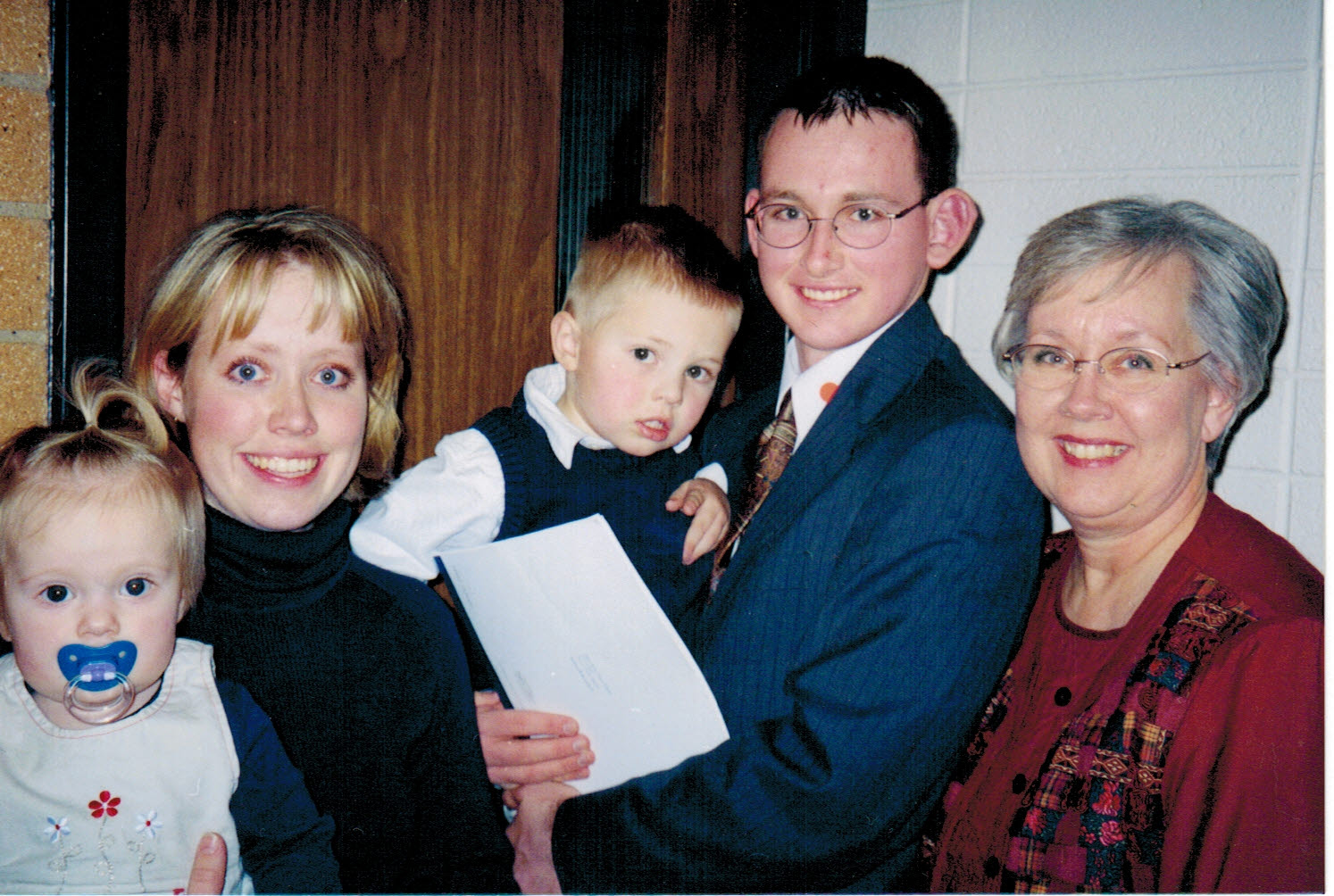
Can you tell which one is me? Hint, I don't have a pacifier in my mouth.
At the time I was still in the process of getting all of my required shots. There was one series of shots that required 3 shots spread over several months (a hepatitis vaccine if I remember) and I had the first two but had not gotten the third, so on the first day they went ahead and gave me the third and final dose. It turned out that 6 years later that incredibly minor event saved me a lot of trouble and red tape when I was trying to get into graduate school.

You see, in North Carolina where I am currently going to school, state law requires all students to be vaccinated. As a child I received all the standard vaccines and my mom kept a very accurate record of every shot I ever got. Unfortunately my mom is not a certified nurse, so even though the record was very accurate and complete, UNC would not accept that record. So I was facing the prospect of having to get every single shot again to satisfy the bureaucracy of UNC. All my "official" records were spread all over Arizona in who knows what doctor or government office and it would have been an incredibly hard task to track down all those records. But when I entered the MTC I had received one shot. And that one shot went on my record at the BYU health center, and that was the only nurse certified record that I had access to. So I went there to talk to a nurse and get that one record. While I was there I explained my predicament and asked how I might go about tracking down my record. She looked at the meticulous record that my mom had kept of every shot I ever received, and she thought about it for a second and then offered to enter all that information that my mom had kept over the years into the computer (she was only a certified nurse, and not a nurse practitioner, which meant that technically she was not allowed to do this, but she did it anyway). So she sat there and entered everything into the computer, put it all in my file and printed it out. She signed it (again, I think NC state law required the signature of a nurse practitioner but we were already up to our eye balls in "irregularities" and she didn't want to have to track down and explain to a nurse practitioner what was going on so she just did it).

The only reason why she was able to do that was because I had received that one shot on my first day in the MTC so I was already in the system and she just had to "amend" my file. UNC accepted my new file because it was on official health center letter head and had some sort of signature at the bottom, despite the fact that all the information came from the exact same source that they had strenuously told me was unacceptable.

In so many small ways my experience of entering the MTC was crazy and stressful, but there were the tiny things (me getting to talk to Dr. Jones about getting a job, and me getting a shot) that turned out to be tender mercies much later in my life. There were so many other things about my mission, the people I met, the companions I was with, and the areas I was in, I would have never had those opportunities had I not entered the MTC when I did. Even though from an outside perspective the timing may have been very inconvenient it did in fact make it so that so many things were timed just right during my mission and after my mission so that many opportunities were made available all because of when I went into the MTC.

It kind of made up for the fact that the day I went into the MTC was the same day that the first Lord of the Rings movie came out. But it was OK since I came home and was able to watch the first two in quick succession on DVD and then go see the third one in the theater. Well worth the wait.

Friday, September 6, 2013

Key Differences in the BoM and Isaiah Texts

[This is a cross post from my other blog where I am doing a side-by-side comparison of Isaiah chapters and quotes found in the Book of Mormon.]

After doing a side-by-side comparison of 21 Isaiah chapters in the Book of Mormon I noticed a few interesting things about the variations in the texts. There are many very minor variations between the two texts, but there are also some major variations that quite significantly change the meaning. There are some differences that can obviously be attributed scribal error, on the part of Joseph Smith or Oliver Cowdery (or others, such as the printer) that were never found or corrected. Still there are others that point to a difference of translation, and still others that indicate a fundamentally different text from the ones used in translating the Bible. I will try to give examples of each of these interesting differences below.

I was also impressed with how consistent the two texts are, even though there are obvious differences. After going over the two texts from the Book of Mormon and Bible, I could tell that the text found in the Book of Mormon was not a simple, sloppy, or ignorant attempt at plagiarism of Isaiah found in the KJV Bible. The differences and distinctions are too nuanced, and even when they differ the differences are too unintentional that it would take a world class scholar to produce them, or a very inspired man.

In no particular order here are a few of the interesting differences.

Difference in Translation

Differences in the text are marked in RED.
Variations in the text are marked in ROSE.
Mosiah 14:9
Differences in the text are marked in BLUE.
Variations in the text are marked in GREEN.
Isaiah 53:9

9 And he made his grave with the wicked, and with the rich in his death; because he had done no evil, neither was any deceit in his mouth.

9 And he made his grave with the wicked, and with the rich in his death; because he had done no violence, neither was any deceit in his mouth.

In these verses there is one difference, the word violence is replaced with the word evil. While we may at first assume that this is a difference in the original texts, instead this appears to be a difference in translation. If we compare many different English translations of the same text almost all of them use the word violence, but if we look at a Bible commentary on that passage we find that the same Hebrew word used in that verse is alternately translated as wrong in other verses in the Bible. When Peter quotes the same verse in his first general epistle he uses the word ἀμαρτία which translates, usually, as sin. Also Jesus himself uses a paraphrase of the verse to defend himself as recorded in John 8:46, with the word in question is again translated as sin. So ultimately what we have here is a rather interesting difference in translation. It is a subtle difference but I think that it is still a valid translation of the original concept.

Scribal Error -- The wrong word

2 Nephi 24:19 Isaiah 14:19

19 But thou art cast out of thy grave like an abominable branch, and the remnant of those that are slain, thrust through with a sword, that go down to the stones of the pit; as a carcass trodden under feet.

19 But thou art cast out of thy grave like an abominable branch, and as the raiment of those that are slain, thrust through with a sword, that go down to the stones of the pit; as a carcase trodden under feet.

I was surprised and intrigued when I found this difference. At first I thought that it could be a difference in translation, much like the previous example, but I looked up other Bible translations and it quickly became apparent that the concept bound up in the original text strongly implied raiment and not remnant. In context, and comparing other similar passages from Isaiah, I am inclined to think that this difference is due to a scribal error. Considering the fact that the two words are very similar when spoken aloud (at least with your standard American accent), and considering the fact that Joseph Smith was dictating the text, it would be very easy for this error to happen. Also because the word remnant makes sense in context this would not be an error that would be easily found and corrected without a review of the original text.

Additional Text -- Slight changes in meaning

2 Nephi 24:2 Isaiah 14:2

2 And the people shall take them and bring them to their place; yea, from far unto the ends of the earth; and they shall return to their lands of promise. And the house of Israel shall possess them, and the land of the Lord shall be for servants and handmaids; and they shall take them captives unto whom they were captives; and they shall rule over their oppressors.

2 And the people shall take them, and bring them to their place: and the house of Israel shall possess them in the land of the Lord for servants and handmaids: and they shall take them captives, whose captives they were; and they shall rule over their oppressors.

In several places there are whole phrases or sentences added that expound on the meaning of the original text. In the verses above there is an additional sentence that adds additional information about what is meant by the verse. There are a few other seemingly minor differences later on in the verse but when they are considered in conjunction with the earlier addition, the subtle changes made to the content is consistent and insightful.

The Missing Words -- Italicized text

2 Nephi 15:28-29 Isaiah 5:28-29

28 Whose arrows shall be sharp, and all their bows bent, and their horses’ hoofs shall be counted like flint, and their wheels like a whirlwind, their roaring like a lion.

28 Whose arrows are sharp, and all their bows bent, their horses’ hoofs shall be counted like flint, and their wheels like a whirlwind:

29 They shall roar like young lions; yea, they shall roar, and lay hold of the prey, and shall carry away safe, and none shall deliver.

29 Their roaring shall be like a lion, they shall roar like young lions: yea, they shall roar, and lay hold of the prey, and shall carry it away safe, and none shall deliver it.

After doing a few chapters I decided that I needed to keep track of the italicized text in the Bible. For those who don't know, in the KJV of the Bible there are many words that are in italics. These are words that do not appear in the original Greek or Hebrew, but must be added to make it grammatically correct in English. For any one who has learned a foreign language this is something obvious about translation. Sometimes certain words (pronouns, participles, adverbs etc.) are not needed in another language, but are needed in English. After a while I noticed that a number, but not all, of the italicized words in the KJV were either missing or different in the Book of Mormon. This would indicate a slightly more literal translation was used for the Book of Mormon. That was a particularly remarkable realization and changed the way I viewed the basic text of the Book of Mormon.

Also there were a few cases where a phrase that appeared in a previous verse was moved to the next verse in the corresponding chapter and verses. The two above verses are an example of that.

Joseph Smith's Commentary

1 Nephi 20:1 Isaiah 48:1

1 Hearken and hear this, O house of Jacob, who are called by the name of Israel, and are come forth out of the waters of Judah, or out of the waters of baptism, who swear by the name of the Lord, and make mention of the God of Israel, yet they swear not in truth nor in righteousness.

1 Hear ye this, O house of Jacob, which are called by the name of Israel, and are come forth out of the waters of Judah, which swear by the name of the Lord, and make mention of the God of Israel, but not in truth, nor in righteousness.

The very first chapter that I did, the very first verse, turned out to be one of the most interesting in terms of providing insight into not only how the translation process worked, but also Joseph Smith's idea of what it meant to "translate" something. If Joseph Smith had ever had the opportunity to attend a real university, and if he had taken a class on Biblical Hebrew then he surely would have failed the class and would have driven the professor to the point of insanity. Joseph Smith's idea of "translation" was to say or write down whatever he thought it meant, not what it actually said.

Fortunately Joseph's translation of the Book of Mormon was more of a revelatory process and not an academic process, which is what most people think of when they hear the word "translation". Most people think that Joseph sat there and translated, in an academic sense, the etchings on the gold plates, which would have required him to actually learn Reformed Egyptian. But from the many accounts of people who witnessed the translation process, the translation was more of an inspired revelation that utilized the resources of Joseph's mind to formulate the text into English. It was by all measures quite remarkable.

So why this little rant of mine? Because of the phrase "or out of the waters of baptism". That phrase does not appear in original manuscript, nor in the printer's manuscript, nor in the 1830 edition of the Book of Mormon, but it does appear in the 1840 edition of the Book of Mormon. What that phrase appears to be is a "prophetic commentary" by Joseph Smith. It is something that he apparently had no problem adding to the text as he considered it his job to "translate" and to expound scripture, but it is something that would make academics working on a translation tear out their hair and curl up in a ball in the corner of the room and cry for hours on end. It is a major indication that Joseph Smith did not understand translation in the same way that you and I view translation. Upon finding out that he would change the text like that some people would, and do, criticize him for improperly changing the meaning, but as far as we can tell this is the only instance of "prophetic commentary" by Joseph Smith in the Book of Mormon. The rest of the text seems to be as it was on the gold plates.

Conclusion

To be honest I was never wild about Isaiah like some people are in the Church. It never crossed my mind to take the class Writings of Isaiah at BYU. I did, and still do, read Isaiah in my personal scripture study. I think that by far my favorite chapter in all of scripture is 3 Nephi 22, which is also Isaiah 54, so it cannot be said that I dislike Isaiah, it's just that never felt an intense desire to take a class devoted to Isaiah, or to write a book about him. So it may be a little odd that I spent, and will still spend so much time on this project. Still, I think I learned more about Joseph Smith and how he translated the Book of Mormon than I did about Isaiah by doing this. It definitely changed the way I view the actual text found in the Book of Mormon and it gave me a greater appreciation of how real, and in some cases, how literal the text is. I think the translation is a very good one and will stand the test of time.

Wednesday, August 28, 2013

Was Lehi a Samaritan?

A few days ago I read an article entitled "Who Were the Samaritans?" on Interpreter that I thought was very interesting. It gave a basic outline of the Samaritans from their perspective and not from the perspective of the Jews and early Christians. The entire article is worth the read, but I will sum up the important points that are relevant to my current post.

I remember being taught in Seminary, Sunday School, Institute classes and in Religion classes at BYU that the Samaritans were descended from the people brought in by the Assyrians after they conquered the northern kingdom. What I had been taught was that the Assyrians carried away the remaining Israelites and brought in other conquered people and told them to worship the god of the land (meaning the Hebrew god). Thus the Samaritans, although they followed the Mosaic Law, were considered illegitimate and not true Israelites and thus were excluded from all official worship, rights, and privileges. They were therefore looked down upon by the time Jesus began his ministry. This negative view formed the basis of the parable of the Good Samaritan, and also Jesus teaching the woman at the well.

It's a nice neat picture and seems to be supported by history, and the Bible, until you hear the Samaritans' side of the story.

The Samaritans consider themselves to be pure descendants from Israel (yes I used the proper verb tense, the Samaritans are still around), and have a slightly different version of what happened. The split between the northern and southern kingdoms goes back to the time of the prophet Samuel and the high priest Eli, and the high priest Uzzi. ("huh? what? who in the world is Uzzi?", well that's the point, the Jews don't like to talk about him, so that is why you never heard his story.) If you read the Bible (that is the collection of books, prophecies, and histories kept by the Jews, emphasis on the Jew part) then you can read the story of how the high priest Eli wasn't such a great guy because he didn't do anything about his sons wickedness. God had to speak to the young boy Samuel at night to get him to tell Eli that he (Eli) had been rejected as high priest. Thus began the prophetic career of Samuel who would go on to be prophet and anoint Saul as king of Israel.

The part that you never hear, but is told by the Samaritans is that Eli actually wasn't the legitimate high priest, Uzzi was. But because Uzzi was only a young boy he could not act as high priest, but Eli wanted to take over the post. There was an intense debate regarding who should be the high priest. The tribe of Judah supported the usurper Eli while the other tribes supported Uzzi as the legitimate successor of Aaron. This started the general rift between the tribe of Judah and all the other tribes (as a side note, it would appear that this was the basis of the north-south split that would not break out until after king Solomon died). So each kingdom traced their priesthood authority back to what they considered to be the legitimate source, and each kept their own history, prophecies and revelations, but almost all of the history kept by the northern kingdom was lost when the Assyrians destroyed the capital Samaria. Thus the only surviving histories that we have are those kept by the Jews that may have been edited for political reasons (i.e. "We aren't going to tell their side of the story." and "We won't include the writings of these prophets in our scriptures because they are "Northern" prophets.").

So where does Lehi fit into all of this? If you recall, after Lehi's sons returned from Jerusalem with the brass plates, Lehi (or at least Nephi, according to how he told the story many years later) was surprised to learn that he was descended from Joseph. Apparently this was significant enough that Lehi decided to name his a son after Joseph. So why was this significant? If you recall from what was previously explained, in the social, political, and historical context that Lehi (and Nephi) came from this meant that they learned, perhaps for the first time, that they were not Jews. To them this may have been a real paradigm changer since they realized that they were actually part of the alternate history of the northern kingdom. If you carefully review all instances where Nephi refers to the Jews, you will find that Nephi never refers to himself or his descendants as Jews. They are referred to as a remnant of the house of Israel, but never Jews. In fact if you reread the verses where Nephi references the Jews you may get a sense that he considers them to be a separate people from him, his ancestors, and his descendants.

We learn later that Lehi was actually descended from Manasseh, which would put him, historically, as a member of the northern kingdom. It could be that Lehi's family fled Samaria (or some other place up north) when the northern kingdom was overthrown by the Assyrians, or they could have come later, we will never be sure. It seems that by the time it got to Lehi it may have been a little unclear which tribe he was descended from. But in any event, by being descended from Manasseh would mean that Lehi was technically part of the people who were considered to be, or would later be called Samaritans. We are not sure when the people who were the remnant of the northern kingdom were labeled as Samaritans, and based on the information provided in the article that I linked to at the very beginning the intense animosity between the Jews and Samaritans may not have come to fruition until after the Jews' return from their Babylonian captivity. Thus the kind of animosity that we find in the New Testament most likely grew in the 600 years that separated Lehi from New Testament times.

So why else may all this have been significant? I find it interesting that God was so particular that Lehi send his sons back to Jerusalem to get the records from Laban. Were there not any other scriptures lying about Jerusalem that were easier to get? Or perhaps they had to go get that particular set which, because it is implied that Lehi and Laban were somehow related, were the scriptures kept by the Samaritans living in Jerusalem, and thus had a slightly different set of prophetic writings, including Neum, Zenos, Zenock and Ezias (for wild speculations as to who Ezias was read my ramblings here, perhaps my conclusions in that post are extremely interesting considering the current topic). Something interesting to consider.

So in the end, was Lehi a Samaritan? Well, in the sense that we tend to think of Samaritans, no he wasn't. But he was a descendant of Manasseh, which would make him one of  the people of northern kingdom. Those people would eventually become the Samaritans that we know from the New Testament, and that are still around today. So strictly speaking we can't call Lehi a Samaritan, but based on the writings of Nephi, it would seem that we can't call them Jews either, and that I think is something to think about.

Thursday, August 8, 2013

Stories from My Mission: "You need to repent!"

I won't say where this story happened so that I can preserve the identity of those involved.

In my mission there was a senior couple, the Elder and Sister Wilcox, who were serving as missionaries. Shortly after they arrived Elder Wilcox was asked to serve as a counselor in the Mission Presidency. This meant that he would travel to the various District Conferences (like Stake Conferences) where the Mission President was unable to attend (we had about 15 districts in our mission). It was during one of these conferences that I was asked to accompany Elder Wilcox in an interview. He was not very proficient in Spanish and needed someone to translate for him.

The man Elder Wilcox was going to interview was someone who had been a member for many years but recently had been disfellowshipped. The purpose of the interview was to sort out the problems and to see if the man could return to full fellowship in the Church.

The interview began as a simple fact finding procedure, "So what is your story? When you were disfellowshipped by the District Presidency what were the reasons they told you? What have you done about it?" etc. According to this man's version of events, he was disfellowshipped for having a general disagreement with the local church leaders. Basically what it came down to was they, the church leaders, didn't like him, and he didn't like them so they told him that he couldn't use his priesthood and that he couldn't hold a calling.

Since I was only there as an interpreter and a facilitator I didn't have any say in the matter, and I will refrain from making any statement about who was right other than what Elder Wilcox ultimately decided.

To back up his case he said that he was a good man who did many good things. He said that he took care of his children, even those who were not strictly his children. He mentioned that before he met his wife she had worked as a prostitute and had three children from that. When he married her he took those children as his own and raised them accordingly. He was even sealed to them in the temple (which in this part of Argentina, to have a family like that who had been to the temple was very rare). He used this and other examples to make the case that he was a good man who tried to live within the covenants and commandments.

He then made the case that the District President was not so holy (they were neighbors). He related an experience where he said that he saw the District President beat one of his children in a rather harsh manner. He said that his being disfellowshipped was simply a result of the District President projecting his own sins and failing on him.

After listening to all of this, and after I made sure that Elder Wilcox had understood everything that had been said, Elder Wilcox paused, bowed his head as if in prayer or contemplation for a moment. Then he raised his head, looked the man in the eye and in flawless Spanish told the man, "You need to repent! The problem here is that you have not forgiven your wife! That is what you need to repent of!"

The man was rather taken back, because up until now this had all been about the dispute between him and the District President, but the thought that the real problem was one between this man and his wife had never occurred to him.

Elder Wilcox continued on and explained, "You have never forgiven your wife for the things she did before she met you. You said that she worked as a prostitute before she met you, and you said that you married her anyway. You said that you brought her to church, along with her children who were born of her prostitution, and that this made you a good man. She has been baptized, she has gone to the temple and wears the holy garment."

"The Lord has forgiven her her sins and remembers them no more. But you still remember them and you still think of her being defined by her past sins. You should not have mentioned them or even brought them up. You will not be forgiven until you humble yourself and never speak of her past sins any more. She has given them up, and the Lord has accepted her repentance. Now you need to accept her change of life."

When the man heard this he was left almost speechless. He said that no one had ever told him that. He didn't realize that his perception of his wife was having such a profound impact on him and how he viewed others. In a moment his entire demeanor changed. Whereas before he seemed to be inflated with pride and wounded pride as having been disfellowshipped, be was now immensely humble and contrite. It was as if in a moment all his pride was stripped away from him. He promised that he would forgive his wife, and that he would never again mention her past sins. The issue between him and the District President was not even mentioned again. Due to the force of the Spirit that accompanied Elder Wilcox's admonition he had experienced a sudden and dramatic change of heart.

Monday, August 5, 2013

Stories from My Mission: The Butcher Fist Bump

I thought I should share a some what shorter and lighter story after my last two.

In my first area of Bella Vista there were many things that I had to learn about Argentina. One of the minor things that I had to pick up was how butchers greeted people. Because they work with meat their hands are usually covered in meat juices, and everyone else's hands are well, covered in who knows what. So butchers don't shake hands. What they do instead is extend their hand in a fist are you are expected to grab their forearm just above the wrist and "shake" their hand.

The first time I met a butcher and he extended his closed fist to me I had no idea what I was supposed to do. So I did the only thing I could think of, I gave him a fist bump. My companion, Elder Tenny, busted up laughing and the butcher was very confused, and I had no idea what was going on. Elder Tenny thankfully took the time to explain to the butcher what I had done and to explain to me the proper way of "shaking hands" with a butcher. I still think my way is better.

Sunday, August 4, 2013

Stories from My Mission: The things you don't tell your parents about. (Part 1)

I will go ahead and label this post "Part 1" since there were many things that happened to me on my mission that I, um, just didn't write home about. Not because I had done anything wrong, but there were just the little things that happened that I never told them because I really didn't want to make my parents worry about me. I have no idea how many of these stories I have. I did tell my parents some of my big stories, like being bitten by a dog, breaking my rib, or being robbed on the street, but there were all the other little stories that I didn't bother to write them about.

In my fourth area in the city of Eldorado I had one companion, Elder Caballero, who I was with for one transfer (before I was "emergency transferred" out of the area during a normal transfer, but that is another story. Wait, I don't think I ever told my parents about that one... I told them about my first emergency transfer that brought me to Eldorado, but I don't think I ever told them about why I had to leave Eldorado...oops. Anyway back to my normal story.) So, Elder Caballero was a very outspoken Paraguayan who always made it clear what he thought about things. In Paraguay they speak both Spanish and Guarani so he was obviously fluent in both. I on the other hand only knew how to say 5 or 6 words in Guarani, and two of them were "jagua piru" which means "skinny dog", so in other words, I knew nothing in Guarani. In the city of Eldorado about a third of the people were Paraguayans, and thus there were a lot of people who spoke Guarani.

One day after returning from a mission conference in Posadas, we were getting off the bus and my companion bumped into a woman as he was walking down the aisle of the bus. He turned towards her and said, "Excuse me." and then moved on and didn't think any more about what had happened. We were walking down the street about 2 hours later when a man approached us. All of the talking that happened next happened in Guarani so I didn't understand a word of it, but I could understand the man's tone. My companion explained afterwards what he had said.

We almost walked right past each other on the street but at the last moment the man turned and planted himself in front of my companion. He pointed his finger at my companion's chest and asked him if he was the one who had disrespected the woman on the bus. My companion was at first confused, but the man said that he remembered seeing my companion step on the woman's foot on the bus earlier. My companion said he was unaware of the fact that he had stepped on her foot but he said he was sorry about it. The man was not placated and continued to accuse him harshly with his finger now pointed directly at my companions face.

It was at this point that I noticed the ring on the man's finger. It was, shall we say, bone white and had a swastika carved into it. There was something about the man that was very unsettling. He continued to accuse my companion of "disrespecting" the woman and my companion continued to apologize profusely. The man was insisting that my companion would have to do something to satisfy her "wounded honor", and the general implication was that it would somehow involve a knife. My companion, Elder Caballero, who I had seen stand up to toughs on the street, listened to him talk big and would let nothing diminish his honor was obviously disturbed by the man's accusations and was trying to apologize and placate the man as best he could.

Eventually the man was satisfied with what ever my companion told him and with a parting warning he walked off. After the man left Elder Caballero explained to me what the man had said. My companion also told be about how in Paraguay someone's honor is a very serious thing, and to violate someone's honor could provoke serious consequences. My companion knew people who had been knifed over wounded honor (for example, my companion's full last name was Caballero-Ruiz Dias, but he only went by Caballero since another family in Paraguay had a blood feud with the Ruiz Dias family). So for my companion when the man accused him of dishonoring the woman on the bus, this was a very serious thing, especially considering the man's, um, shall we say, choice in jewelry. We were both a little shaken by the experience.

We explained what happened to our branch president. He was concerned but there was nothing he could do. We told our zone leader and mentioned it to the Elders in the mission office, they filed it away behind all the robbings, and kidnappings that happened in my mission (we averaged about one companionship per year was kidnapped/held hostage and robbed per year, which doesn't include all the street muggings at knife/gun point which happened every two or three months or so...something else I never mentioned to my parents...). Since there really wasn't much we could do we just chose to ignore it. Fortunately we never saw that man again.

Stories from My Mission: "She is in the twilight of her day of grace."

This story is perhaps a little more sensitive than most. Do not judge any of the people involved too harshly. The true nature of this story can only be understood if you have a truly eternal perspective of the nature of our existence, and of eternal progression. Also realize that what I write here is only a small part of what happened, thus be mindful of that when deciding whether the actions of everyone involved were justified or not. Some times I wonder about whether or not some of my actions were correct or not.

I will not say where or when this happened and I will try to keep it as anonymous as possible.

Sometime after arriving in my new area I met the family, which consisted of the mother, two daughters and a son. The two younger children, a boy and a girl, were already members of the Church but I only recall seeing them attend church a few times while I was in the area. I never found out anything about the father. The home situation was shall we say, less than ideal. The mother had health and mental issues which meant that she could not work very much, the eldest daughter had previously worked as a prostitute and had been forced to stop working due to her getting pregnant (and had been unwilling to get an abortion).

From what I could gather the family had been meeting off and on with the missionaries for about 5 or 6 years. The two youngest children had been baptized about a year before I got to the area, but the oldest daughter had not been baptized due to her profession, and the mother, well, that is the point of this story.

With my first companion we made a few visits to the family, but it was not until my second companion was in the area that things started to change. We were meeting more with the oldest daughter, partly because she was coming to the realization that her choice of profession was not a very good one and was making an honest effort to change, partly for her own sake but also because she realized that she didn't want her own child to grow up like her and viewed the Church as the best way of protecting her unborn child.

Every time we visited the mother would insist on telling us that she knew the Book of Mormon was the word of God and that Joseph Smith was his prophet, but when ever we asked her to come to church he answers would be evasive and inconsistent. We encouraged, prodded, cajoled, joked, exhorted and commanded, but she never came to church. Try as we might we couldn't get her to make the effort to come to sacrament meeting. She kept telling us that she knew she needed to get baptized and she even informed us that if she could get baptized then there were some things about her life that could get fixed.

There never was any indication that there were any major sins (i.e. prostitution, drugs, tobacco, alcohol, murder etc.) that prevented the mother from getting baptized so we were a bit baffled as to why she would never come to church. There always seemed to be some excuse (i.e. it rained, it was hot/cold, she was sick, her legs hurt, they had to go visit their cousin etc.).

During all of this I felt the need to keep visiting them. It was not a strong feeling or an impulsive feeling, just a gentle feeling that I should keep stopping by. All this came to a head when my third companion got to the area. Of my three companions in the area my second companion had the greatest rapport with the family. My third companion, not so much. After just a few weeks my companion was getting impatient with them and began making comments about how we shouldn't waste any more time visiting them. But I had seen how desperately the mother and daughter had wanted to change their lives and I just wanted to be there when they finally decided to take the first step.

I visited the family a few times with my new companion but I he was getting more and more impatient with them and with me. Things fell apart one night when we went to visit them and my companion insisted that we have some members there with us (getting members to help us out was not the easiest thing on my mission). This meant that we were late getting there and when we did arrive something about the family was very off. The eldest daughter was upset with us because we were late and yelled at us (with two Aaronic priesthood boys aged 14 and 16 who were with us, the only ones we could find on short notice).

After the yelling stopped the mother came out and was visibly upset with us, and while she spoke to us from her front porch she became more and more incoherent at some point she went back into her house, but didn't get very far when she was overcome by some type of epileptic seizure. I saw her start to seize up and I sprang into action. I dashed through the front door and with the help of her oldest daughter we got her sitting in a chair. Her convulsions were not very violent, but she was unable to speak. My companion, who had wanted nothing to do with the family, stayed outside even refusing to set foot in the house, even when I asked him to come help me give her a blessing. Because my companion was refusing to come in and I was unsure what to do I went ahead and placed my hands on her head and gave her a blessing.

I don't know what I was expecting, perhaps something miraculous, but instead she got worse. Again with the help of her daughter we were able to carry her into her room and lay her down on her bed. After a while her condition improved and she motioned to us to get a Book of Mormon that she kept on her bedside table. She took it and held it close to her chest and when she did that she seemed to calm down a bit more. After a while she was able to speak again and told me that when she gets bad she uses the Book of Mormon to calm her fits. She said that only the word of God could cure her of her ailment.

After making sure that she would be fine I exited the house and rejoined my companion, who had been standing outside, along with the two young men who were looking very awkward. As we walked away I told the two boys that it probably wouldn't be a good idea to talk about what had happened. I told them that it was OK to tell their parents but no one else. My companion didn't say anything until we got home. I don't remember what he said exactly but one thing he said was that he would never return to visit that house. This put me in a predicament because I suddenly felt a stronger need to visit them again to resolve some things that came up. Not knowing what to do I contacted my zone leader to see what he had to say. He agreed to come to the area so that he and I could visit with the family so that he could make an assessment of the situation.

Approximately a week later my zone leader came to our area and I went with him to visit the family. He spoke to the mother and all the children. He asked about their desires to get baptized, or whether those who were baptized would come to church. There were no dramatics or apparent problems. He couldn't figure out why the mother wouldn't come to church, the eldest daughter on the other hand was about 7 months pregnant at that point and had a hard time making it all the way to church. After meeting with them he said that he didn't find anything majorly wrong with them, except for the fact that the mother who had spent 6 years meeting with the missionaries had never come to church, despite her insistence on knowing that it was true, and that it would help her.

Shortly after this the mother did make the trek all the way to church, but only after the meetings were all done and the only person there was the branch president and his one counselor. She came asking the branch president for a blessing and he obliged. Because I was not present at the time what happened next was told to me by the branch president. In the middle of giving her a blessing she entered into one of her fits. The branch president said that when this happened he felt something wrong with her, beyond the obvious medical or mental issues, and was given to know by the Spirit that she was possessed by an evil spirit. So right then and there he exorcised the evil spirit from her. She calmed down significantly after he did that.

After this happened he met with me and we discussed everything that had happened. After much discussion he decided to go with me, and me alone because my companion refused to go, to visit the family because both he and I felt it necessary. It was in this meeting that the branch president told me something about the mother that I had not known previously. Before meeting the missionaries and coming in contact with the Church the mother, but not any of her children, had attended a certain Assembly of God church in the city. This particular denomination was known by the missionaries, due to the number of run-ins that we had with its members and pastors. There seemed to be at least one of this particular strand of Pentecostal church in every area that I lived in and no one seemed to every have anything good to say about them.

While this church was affiliated with the Assemblies of God movement that started in the US in the early 1900's, the particular sub-denomination that the mother attended was of a variety that had started independently in Brazil. They were known for being more extreme in their displays of "being filled with the spirit" and "speaking in tongues" than all the other Assemblies of God churches. The branch president told me that he had heard very bad things about that church and that most of the people who had spent any amount of time there end up being very messed up. That is apparently what happened to the mother, and somewhere along the way she had become possessed.

Shortly after this I went with the branch president to visit the family so that he could make an assessment about how the two children who were members of the Church were doing and to get an idea of what the eldest daughter was like, and to meet with the mother again. We both knew that we needed to go. So I left my companion with another priesthood holder (he was still upset that I was going to visit the family) and went with the branch president to meet the family.

I had been thinking a great deal about what had been going on and I was wondering why I felt the need to keep visiting the family. While meeting the family with the branch president was uneventful as we left we were talking about the situation and wondering what to do. That is when I received the key insight about the whole situation and shared it with the branch president. I didn't have the proper words to say it in Spanish so I had to first ask the branch president for the proper word. What I told him was, "She is in the twilight of her day of grace." When I said this he turned and looked back at their house as we walked away and paused, nodded and expressed regret that we had to see this.

What we both realized is that the mother had been given many, many opportunities to accept the truth. But she had made conscious decisions that resulted in many of her problems. Because she continued to refuse to come to church, despite all her experiences, she was quickly approaching the end of her day of grace when she would have no more opportunities to accept Jesus Christ. Not in this life or the next. This was her last chance, and the reason why I was prompted to be there (along with the branch president after my companion refused to go) was to bear witness of the twilight of her day of grace. She never did come to church. He two youngest did start coming again after I left, but she never did.