I passed my qualifying exam. I actually took it two weeks ago but I just found out today that I passed it. I have a much longer explanation of the qual over at The Eternal Universe, but I just wanted to say something here that I did not mention there.
When I was preparing for the qual I was wondering what I should do to focus my studying. It was something that I was praying about and thinking about a lot. There are so many things I could study and look at that it would not be possible to look at them all, so I had the be selective in the things that I studied. As I was praying about this I got the impression that I should focus on the statistical mechanics portion of a book containing old qualifier problems from the University of Chicago. So I went to that portion of the Chicago book and looked it over and selected the problems that I thought could turn up on the test (I selected 17 of the 22 problems) and worked them out. As it turned out two of those questions turned up on the qualifying exam, and I was able to answer them easily.
The test was also spread over two days. Initially it was scheduled to be on Sunday and Monday the 9th and 10th of May, but the department secretary pointed out that Commencement was that Sunday and there would be several people in the building making noise and it would be hard to reserve a room. This prompted the chair of the qualifying committee to propose moving the first day of testing to Friday the 7th. I sent an email to him saying I would much prefer moving it to the Friday, so it was moved from Sunday to Friday.
Also, I was preparing for the test by studying with two other people, who were also taking the astronomy test like me. We had looked at many different things and we were finalizing our last minute studying. We had two tests on the Friday and four on Monday. So we planned to spend Saturday studying for the first two tests (stat mech and quantum) and then they wanted to spend Sunday studying for stars and high energy. I decided that even though it would help to study for stars and high energy some more as those were the two that I had not studied as much, it would be better for me to keep the sabbath and not to study. So I studied with them on Saturday and then on Sunday I went to church, had our home teachers come by and spent the day "resting" (i.e. worrying about my tests the next day). But when it came time for the tests, it turned out that everything that I was able to answer on the tests was stuff that I had already studied, or already knew, and thus it turned out that if I had studied on Sunday then that would not have helped me any on the two tests. It was such a good feeling to see a blessing of keeping the sabbath.
Sunday, May 23, 2010


Tuesday, April 20, 2010
Failing (Second) Marriages?
The other day I was reading a story and one woman in the story expressed the thought that there was no point in getting married a second time because "The statistics on second marriages aren't great." This struck me as a fairly odd statement. To understand why this is, it is kind of like saying, "I don't want to get a driver's license because the statistics on the number of people who drive drunk aren't great. I mean what if that happens to me?" Who says you have to drive drunk? or even drink for that matter?
So when I was reading that story and I came across that statement, I found it to be very odd, because it expressed the sentiment that divorce and separation was inevitable. Essentially this sentiment treats marriage as a random statistical thing that only has a probabilistic outcome independent of anything we choose or do. If this really were the case with our lives then how many people would get driver's licenses, or go to school and get a grade (think about it, half of all students get below average grades).
So when I was reading that story and I came across that statement, I found it to be very odd, because it expressed the sentiment that divorce and separation was inevitable. Essentially this sentiment treats marriage as a random statistical thing that only has a probabilistic outcome independent of anything we choose or do. If this really were the case with our lives then how many people would get driver's licenses, or go to school and get a grade (think about it, half of all students get below average grades).
Sunday, April 18, 2010
On How We Know It's True
I just thought that I would share some thoughts on how we know something to be true. I was impressed the last few days as I was reading in 3rd Nephi about Christ's visit to the Nephites. After explaining some of the events that occurred we find this simple verse:
At another point in the story, Jesus spoke to the twelve disciples that He had chosen but the rest of the people did not hear what He had said and the author records that "therefore [the multitude] did not bear record; but the Disciples bare record that he gave them power to give the Holy Ghost. And I will show unto you hereafter that this record is true." (3 Ne. 18:37)
In this case only twelve people heard what Christ had said, and they were able to testify that they had been given power to give the Holy Ghost. But this was not enough, because it later had to be shown that not only what they had said was true, but that they actually had the power to give the Holy Ghost. In the next chapter this fact is established and those who witnessed it gave testimony to its veracity.
The common theme here is that whether or not some thing is true is established on the presence of witnesses that can all attest to what happened, including the doctrine that was taught and what Christ had said. The reason why I found this so interesting is that it stands in stark contrast to how many other Christian religions establish the veracity of their doctrine. Related to this idea, I once had a conversation with a friend of mine who is Christian, but is not Mormon, and he told me how he came to know that the Bible was true. The way he described it was that he had had an experience that allowed him to know it was true, but that experience could not be shared with or even conveyed to another person, because it was of "the spirit" and had no external, or provable manifestation.
When he told me this I thought it was very odd because that was directly opposite to everything I had ever known about how God and the Spirit works. As I had been frequently taught growing up, anyone could ask and find out for himself whether or not anything taught by the Church or in the scriptures is true. As one general authority, Elder Rex C. Reeve, put it:
25 And the multitude did see and hear and bear record; and they know that their record is true for they all of them did see and hear, every man for himself; and they were in number about two thousand and five hundred souls; and they did consist of men, women, and children. (3 Nephi 17:25)I find it interesting that the author says that we, "know that their record is true for they all of them did see and hear" (emphasis added). In other words, we can know that what happened was true because the people, and so many of them, actually saw and heard what was done. The truthfulness of the experience came because so many people were able to verify by themselves, and to testify that what was recorded actually did happen.
At another point in the story, Jesus spoke to the twelve disciples that He had chosen but the rest of the people did not hear what He had said and the author records that "therefore [the multitude] did not bear record; but the Disciples bare record that he gave them power to give the Holy Ghost. And I will show unto you hereafter that this record is true." (3 Ne. 18:37)
In this case only twelve people heard what Christ had said, and they were able to testify that they had been given power to give the Holy Ghost. But this was not enough, because it later had to be shown that not only what they had said was true, but that they actually had the power to give the Holy Ghost. In the next chapter this fact is established and those who witnessed it gave testimony to its veracity.
The common theme here is that whether or not some thing is true is established on the presence of witnesses that can all attest to what happened, including the doctrine that was taught and what Christ had said. The reason why I found this so interesting is that it stands in stark contrast to how many other Christian religions establish the veracity of their doctrine. Related to this idea, I once had a conversation with a friend of mine who is Christian, but is not Mormon, and he told me how he came to know that the Bible was true. The way he described it was that he had had an experience that allowed him to know it was true, but that experience could not be shared with or even conveyed to another person, because it was of "the spirit" and had no external, or provable manifestation.
When he told me this I thought it was very odd because that was directly opposite to everything I had ever known about how God and the Spirit works. As I had been frequently taught growing up, anyone could ask and find out for himself whether or not anything taught by the Church or in the scriptures is true. As one general authority, Elder Rex C. Reeve, put it:
We have this message today for each one of you—that the authority of God has been restored and his church has been reestablished in the earth. I testify to you of this truth! But you do not have to take my word for it; you can know for yourselves. Those who are seeking and will humble themselves and reach up to our Father in Heaven in prayer can know of a surety whether or not it is the truth. ("Feed My Sheep" Ensign Nov. 1980)This approach is diametrically opposed to that taken by so many others in Christianity that rely on unverifiable and unprovable assertions of truth. But as we can see from the passages from 3rd Nephi the truth of the doctrine and of special events such as the visitation of Christ to the Nephites is established by verifiable and witnessed events. More than this, as the quote from Elder Reeve shows, individual points of doctrine can be verified and anyone can come to a knowledge of its truthfulness.
Tuesday, March 23, 2010
Perspective on Government Debt
I came across this the other day and I thought that it gave an interesting perspective on government debt. One of the problems with a lot of statistics about the debt is that they are never put into perspective. It is common to always talk about the debt in terms of a raw dollar amount. I think that that is wrong, we need to look at it in terms of ability to pay the debt. For example, if I have a credit card debt of $2,000 then that would be very significant for me right now considering I only make ~$20,000 a year. So my debt reflects 10% of my yearly income. If I graduate and get a job paying $100,000 a year then suddenly my $2,000 debt is no longer as significant (now only 2% of my annual income). As a matter of fact I could probably pay it off with a single pay check. So debt has to be considered in terms of ability to pay it off. While this movie may not be perfect I think it does a good job at putting the debt and our ability to pay it off into perspective.
The question here is who is to blame. Some would say it is the Republicans, others the Democrats, or Ronald Regan, or LBJ, or FDR, but I think it was a fundamental change in the way our society functions. I think it has to do with many people living beyond their means, which means there is only one way to solve this problem.
The question here is who is to blame. Some would say it is the Republicans, others the Democrats, or Ronald Regan, or LBJ, or FDR, but I think it was a fundamental change in the way our society functions. I think it has to do with many people living beyond their means, which means there is only one way to solve this problem.
Sunday, March 21, 2010
Did We Have Our Amalickiah Moment?
Every once in a while there occurs an important event in history that changes the course of history and determines not only the events that a society will face but also the nature and tone of the public, or societal, discourse. Sometimes these important events, while still influential, do not seem to have such an incredible impact at the time. It is only in retrospect that we can look at the course of history and see the point where a society made a choice and then understand how important that choice was, even though it did not seem that way at the time.
For one society one such event came in the form of a rather contentious vote. In The Book of Mormon there is a story included in the Book of Alma about a man named Amalickiah. At this point in time the people, known as the Nephites, had recently switched their form of government from a monarchy to a democracy (probably not a democracy in our modern sense of the word but the laws and judges were voted on and decided by "the voice of the people"). It was at this time that a political controversy arose among the Nephites regarding how the government would be run. There were a group among the Nephites lead by Amalickiah, who apparently thought that the Church of God had too much influence in society and in the affairs of the government. Specifically they objected to the teachings and the preachings of Helaman, the high priest, and his brethren who were the leaders of the Church. The Book of Mormon is not clear about the nature of the dispute, but it is clear that Amalickiah and his followers felt so strongly about the dispute that they decided that the only way to resolve the issue was to make Amalickiah king.
In chapter 46 the situation is described as follows:
Ultimately Amalickiah managed to make himself king of the Lamanites and returned to wage war on the Nephites and attempted to conquer them. But due to the leadership of Moroni and others and the help of God the Nephites were able to defeat the Lamanites lead by Amalickiah, and after Amalickiah died, by his brother Ammoron. This war, the Amalickiah-Ammoron war, was the most destructive and devastating that the Nephites had ever experienced up to that point in their history, but the course of history for the Nephites would have been radically different if Amalickiah had managed to become king in the first place. At that point in Nephite history the people were still getting used to the idea of democracy and were still working out the issues.
The critical question involved with the Amalickiah issue was whether or not the democracy would survive and whether or not the people would preserve their liberty. On the one hand if the people had chosen to elect Amalickiah as their king then that would have ultimately lead to a loss of liberty and a destruction of their freedom of worship and security. On the other hand, by rejecting Amalickiah they did not manage to prevent a terrible war but they did set a precedent that allowed them to preserve their freedom and their government for many years. Even though afterwards others attempted to become king, they were never successful and liberty and freedom were preserved allowing the people of God to be free to worship.
Thus the Amalickiah moment, as it may be called, was a critical juncture in the history of that society. At the time it may have seemed critical, but for other reasons, but in retrospect it can be seen that it was a critical test for their democracy and their freedom. And this realization makes me wonder, have we had similar Amalickiah moments in our history?
Two years ago one of the most contentious votes in recent US history came when the state of California voted on Proposition 8. While there was no direct threat to the government at the time (i.e. no one was advocating to abolish our democracy and establish a king) there were involved with the Prop. 8 issue the same things that were involved with the Amalickiah issue. While there was a specific question being voted on, the larger issue involved was the nature and role of religious ideals in our public discourse. In both cases the issue at stake was whether or not religious opinions and ideals could be used as the basis of government policy. The question was whether or not people would be free to chose and express their religious convictions. In short, the question was whether or not the people would retain their liberty.
But in 2008 the vote was held in California (and Arizona and Florida) and it came out in favor of the family and religious convictions. The question now is how will those who were defeated by the vote react? In the case of Amalickiah, he "saw that his people were doubtful concerning the justice of the cause in which they had undertaken—therefore, fearing that he should not gain the point, he took those of his people who would and departed". Now I doubt that same-sex marriage advocates will be leaving the country in droves, but I would not doubt that they will still respond in like manner and try to force the issue through some other way. The problem is we have had our Amalickiah moment and the "voice of the people" has spoken. If they do support freedom and democracy (and fairness and equality) as they claim then they will have a hard time "gaining the point" and some of their supporters may become "doubtful concerning the justice of the cause".
The thing to note here is that Prop. 8 did not settle the issue but, like the Amalickiah moment, it created a precedent that allowed liberty and religious freedom to be preserved. There were two outcomes, on the one hand it would have lead to an eroding of personal liberty and freedom, while on the other, even though it did not immediately fix the problem, it did allow the people to retain their liberty to continue living in their free society.
For one society one such event came in the form of a rather contentious vote. In The Book of Mormon there is a story included in the Book of Alma about a man named Amalickiah. At this point in time the people, known as the Nephites, had recently switched their form of government from a monarchy to a democracy (probably not a democracy in our modern sense of the word but the laws and judges were voted on and decided by "the voice of the people"). It was at this time that a political controversy arose among the Nephites regarding how the government would be run. There were a group among the Nephites lead by Amalickiah, who apparently thought that the Church of God had too much influence in society and in the affairs of the government. Specifically they objected to the teachings and the preachings of Helaman, the high priest, and his brethren who were the leaders of the Church. The Book of Mormon is not clear about the nature of the dispute, but it is clear that Amalickiah and his followers felt so strongly about the dispute that they decided that the only way to resolve the issue was to make Amalickiah king.
In chapter 46 the situation is described as follows:
1 And it came to pass that as many as would not hearken to the words of Helaman and his brethren were gathered together against their brethren.It was at this time that Moroni, who was the chief captain over the armies of the Nephites, raised the Title of Liberty and gathered the people together who still supported the government. After gathering the supporters of the government together the story records that:3 Now the leader of those who were wroth against their brethren was a large and a strong man; and his name was Amalickiah.4 And Amalickiah was desirous to be a king; and those people who were wroth were also desirous that he should be their king; and they were the greater part of them the lower judges of the land, and they were seeking for power.5 And they had been led by the flatteries of Amalickiah, that if they would support him and establish him to be their king that he would make them rulers over the people.7 And there were many in the church who believed in the flattering words of Amalickiah, therefore they dissented even from the church; and thus were the affairs of the people of Nephi exceedingly precarious and dangerous.6 Thus they were led away by Amalickiah to dissensions, notwithstanding the preaching of Helaman and his brethren, yea, notwithstanding their exceedingly great care over the church, for they were high priests over the church.
29 And it came to pass that when Amalickiah saw that the people of Moroni were more numerous than the Amalickiahites—and he also saw that his people were doubtful concerning the justice of the cause in which they had undertaken—therefore, fearing that he should not gain the point, he took those of his people who would and departed into the land of Nephi.Essentially a vote was held to determine whether or not the control of government would pass to Amalickiah, but due to the outcome of the vote it became evident that the majority of the people would not support him. When this happened, rather than accept the will of the people Amalickiah chose to leave the country rather than accept the result. The problem with this was that, as Moroni realized, if Amalickiah left the country and joined forces with their enemies then Amalickiah would eventually return with an army to conquer the land. So to prevent this, Moroni went with an army to stop the people of Amalickiah from leaving. While Moroni was able to prevent the people of Amalickiah from leaving, Amalickiah himself was not caught and managed to escape to the land of the Lamanites.
Ultimately Amalickiah managed to make himself king of the Lamanites and returned to wage war on the Nephites and attempted to conquer them. But due to the leadership of Moroni and others and the help of God the Nephites were able to defeat the Lamanites lead by Amalickiah, and after Amalickiah died, by his brother Ammoron. This war, the Amalickiah-Ammoron war, was the most destructive and devastating that the Nephites had ever experienced up to that point in their history, but the course of history for the Nephites would have been radically different if Amalickiah had managed to become king in the first place. At that point in Nephite history the people were still getting used to the idea of democracy and were still working out the issues.
The critical question involved with the Amalickiah issue was whether or not the democracy would survive and whether or not the people would preserve their liberty. On the one hand if the people had chosen to elect Amalickiah as their king then that would have ultimately lead to a loss of liberty and a destruction of their freedom of worship and security. On the other hand, by rejecting Amalickiah they did not manage to prevent a terrible war but they did set a precedent that allowed them to preserve their freedom and their government for many years. Even though afterwards others attempted to become king, they were never successful and liberty and freedom were preserved allowing the people of God to be free to worship.
Thus the Amalickiah moment, as it may be called, was a critical juncture in the history of that society. At the time it may have seemed critical, but for other reasons, but in retrospect it can be seen that it was a critical test for their democracy and their freedom. And this realization makes me wonder, have we had similar Amalickiah moments in our history?
Two years ago one of the most contentious votes in recent US history came when the state of California voted on Proposition 8. While there was no direct threat to the government at the time (i.e. no one was advocating to abolish our democracy and establish a king) there were involved with the Prop. 8 issue the same things that were involved with the Amalickiah issue. While there was a specific question being voted on, the larger issue involved was the nature and role of religious ideals in our public discourse. In both cases the issue at stake was whether or not religious opinions and ideals could be used as the basis of government policy. The question was whether or not people would be free to chose and express their religious convictions. In short, the question was whether or not the people would retain their liberty.
But in 2008 the vote was held in California (and Arizona and Florida) and it came out in favor of the family and religious convictions. The question now is how will those who were defeated by the vote react? In the case of Amalickiah, he "saw that his people were doubtful concerning the justice of the cause in which they had undertaken—therefore, fearing that he should not gain the point, he took those of his people who would and departed". Now I doubt that same-sex marriage advocates will be leaving the country in droves, but I would not doubt that they will still respond in like manner and try to force the issue through some other way. The problem is we have had our Amalickiah moment and the "voice of the people" has spoken. If they do support freedom and democracy (and fairness and equality) as they claim then they will have a hard time "gaining the point" and some of their supporters may become "doubtful concerning the justice of the cause".
The thing to note here is that Prop. 8 did not settle the issue but, like the Amalickiah moment, it created a precedent that allowed liberty and religious freedom to be preserved. There were two outcomes, on the one hand it would have lead to an eroding of personal liberty and freedom, while on the other, even though it did not immediately fix the problem, it did allow the people to retain their liberty to continue living in their free society.
Wednesday, March 17, 2010
Platonic vs. Aristotelian World Views
[Editorial Note: This is also posted on my other blog The Eternal Universe.][Editorial Note: Sorry I did not post this sooner, but I have been busy and I have also been thinking about this for a few weeks. But several people have asked what I meant by Platonic and Aristotelian world views. This is an attempt at an explanation.]
Previously I posted on the "conflict" between science and religion. A critical distinction that I made in that post was the difference between the Platonic and Aristotelian world views. At the time I did not offer an in depth explanation of what constituted a Platonic or Aristotelian world view partly because they are rather difficult (i.e. would take several books) to explain. But not to leave those who are interested with absolutely no explanation I will attempt to give a brief explanation of the fundamentals of both. [Editorial Note: When I am giving an explanation I will often include another word in parentheses after a word which has a technical philosophical definition. The word in parentheses is a more colloquial (common) word used in the same context. Both words are interchangeable but I felt that more than one word was needed to get an idea across while still using the "correct" philosophical language (words). If you find it annoying, sorry. I can't think of a better way of doing it.]
On a basic level a Platonic world view carries with it a fundamental distrust of the material (observable) world. An Aristotelian world view fundamentally assumes that all knowledge comes from the observable world (universe). Note that these ideas are not opposite nor are they even mutually exclusive. But they are two approaches to the same thing, how we know and interact with the world.
In my previous post I implied that the Platonic world view was the root of many problems, and while it is, I should qualify that with an explanation. If not considered rightly a Platonic world view can lead to many philosophical (intellectual) problems. By way of explanation I will use a simple analogy, specifically tailored to my assumed audience, those who read this blog. This analogy will not work for everyone.
When we are first learning physics the standard approach is to learn physics with a heavy emphasis on the algebra involved. This means that the equations are given to us in a standard form, from which we work problems and (hopefully) come to an understanding of the physical principles involved. When we have passed this step and we have achieved a certain level of understanding, generally one then returns to the basic physical principles, and relearns them but now with an emphasis on deriving the equations and solving more complex problems using calculus instead of algebra. This allows us to solve problems and answer questions that were impossible before. Problems such as including wind resistance in projectile motion problems. The underlying physical principles have not changed, just our approach to the problem.
This different approach fundamentally assumes that the world is not as "simple" and "easy" to deal with as is usually presented in introductory physics classes (i.e. the world is not made up of spherical cows). While things may be more difficult, and require more training and experience, the outcome allows more understanding and insight.
For all simple cases there is no difference between an algebra based approached to physics and a calculus based approach. As a matter of fact if we tried to solve every basic physics problem by first writing down the Lagrangian for the system and then finding the equations of motion we would never have time to finish solving all of the simplest problems. So in some cases it may even be advantageous to use an algebra based approach than to use a calculus based approach. But if we do this we must realize that we are using a simplification and to not get bogged down in the potential shortcomings of the purely algebra based approach.
Now relating this back to the Platonic and Aristotelian world views, the Platonic approach recognizes that the world is very messy and is not "ideal", meaning that it cannot easily be reduced down to simple, easily solvable problems. There is no problem with this, as this is also the view taken by an Aristotelian world view. But the problem arises when someone who holds to a Platonic world view begins to think that the universe is actually made up of spherical cows (i.e. atoms are "hard" and perfectly spherical, all things can be considered to be point particles, forces behave exactly like 1/r^2 laws etc.). So the problem is not that spherical cows (simplifications) are used to solve (comprehend) problems (reality) but when we begin to actually think that the universe is made up of spherical cows (ideal, according to our understanding) we run in to intellectual (philosophical) problems (mistakes).
You may be thinking, "What in the world is he talking about? How does this relate to anything important? And does this have any bearing on how the world, and our society works?" Well to answer those questions let me give a few examples.
First, recently there was a post on this blog that included this comic:

Without knowing it (or maybe he did) by posting this comic Joe was showcasing the Platonic world view (and one of the problems with it). Essentially the XKCD comic expresses the idea that the further away from reality we move, the more "ideal" or "pure" we are getting. Implicit in this argument is the assumption that in order to understand the world we must move away from all the "messy" stuff and move in the the realm of pure thought. Only then can we begin to understand anything. It is interesting to note that in seven short comments attached to that post the Platonic world view was debated, debunked and rejected in favor of the Aristotelian world view (and Clark Goble even managed to include both Heidegger's and Wittgenstein's arguments against the Platonic nature of language, impressive. And Bill, John Locke and John Stuart Mill would be proud, though many philosophers would try to lynch you for it).
So other than comics where does any of this show up? Again I need to emphasise that the basis for the Platonic world view is a fundamental distrust of reality (observation, sensations). This fundamental distrust of reality leads to all kinds of weird wacky things, like this gem that my wife came across one day. On a basic level the Platonic (or Platonic like) world view leads people to assume that in order to learn anything "real" or of value, they must disassociate themselves with reality (the physical world). This was the motivation behind the drive to use "experimental drugs", such as LSD, in order to experience things that could not be "experienced" in the physical world (this was explained to me by a philosophy student who "had friends that did drugs").
There are other implications to this but to sum up it, is enough to say that even though the Platonic and Aristotelian approaches to the world both consider the physical world to be "messy" at first, the Platonic approach feels that the "messiness" prevents the discovery of the world and thus in the ideal case we must remove the influences of all the "messy" stuff from reality, including our senses and anything that has to do with our "physical" bodies. The Aristotelian approach recognizes that the world is difficult, and while simplifications (math, equations, words, language) can be used to make it easier, the simplifications are just that, a simplification and not an ideal. Thus a Platonic approach demands that new knowledge comes from the ideal world (Plato's world of Forms), while on the other hand the Aristotelian approach assumes that knowledge comes from observation (sensation) of the physical world, and is verified again by observation. All knowledge according to the Platonic approach, by definition, is not verifiable in the Aristotelian sense, but is entirely determined by whether or not one can "think correctly" about it.
So how does this relate to the original motivation for this post involving the "conflict" between science and religion? On a fundamental level science takes an Aristotelian approach to how we learn and find out things about the universe. It asks, "What do we observe and how can we explain what we observe?" While science (and physics in particular) takes an Aristotelian approach, it is not exclusive. We still see a substantial amount of Platonic thought in science, but it is not as common as it is in other fields of research (Math is one that is substantially Platonic).
Perhaps the most prominent place Platonic thought shows up is in religion. I should emphasize that there is nothing about religion that demands Platonic thought, but at times it does seem rather conducive to Platonic thought as it mostly deals with things that are not (obviously) related to the five senses (I put the "obviously" in there because I disagree with that assertion). But if we are working under a Platonic world view then it makes sense that if one considers the mental or the abstract (the Platonic Forms) to be the most pure and perfect then that is where one would consider their God to be. This leads to the argument that God does not partake of the physical world and does not have any part in it other than being the unmoved mover (important note, there is an important distinction here between having an unmoved mover, as was Aristotle's concept, and thinking of God as the unmoved mover). In the end religion (and other "intellectual" fields, such as philosophy and math) became dominated by Platonic thought, while Aristotelian thought dominated science. Again this was not an exclusive domination (nor even correct) but that is the way it stands today in our society.
This causes problems when the question is asked, "Can you prove that God exists?" A Platonist would respond with a philosophical argument for the existence of God, an Aristotelian would respond with a demonstration of the existence of God. In the first case scientists (who are largely Aristotelian in their approach to knowledge) would reject the arguments as invalid because in order to "prove" anything according to science it must be demonstrated (mathematical proof does not count, it has to be demonstrated by experiment, see string theory). Thus the requirements for "proof" are fundamentally different for the Platonic approach and the Aristotelian approach, and because 80-90% of religion takes a Platonic approach, the tendency of scientists is to reject religion as invalid. Unfortunately this rejection first assumes that religion is fundamentally Platonic, and that any approach to it must first be Platonic (including a "scientific" approach).
This difficulty goes away if an Aristotelian approach is taken with respect to both science and religion. In other words it must be assumed that the same modes of knowing can be used for both, which depending on your views of religion (or science, or both) may be an issue. But if the same method is used for both then all apparent difficulties go away (interesting note: it works both ways, if a Platonic approach is taken in both cases then there is no conflict, but as long as a different approach is taken for either science or religion then there will be a conflict).
So now after this long explanation I will return to what I started out by saying:
On a basic level a Platonic world view carries with it a fundamental distrust of the material (observable) world. An Aristotelian world view fundamentally assumes that all knowledge comes from the observable world (universe). Note that these ideas are not opposite nor are they even mutually exclusive. But they are two approaches to the same thing, how we know and interact with the world.
The problem comes when we take the Platonic distrust of the material world to the point that we think that the material world inhibits our understanding. This is in opposition to the Aristotelian view, which is that even though the observable world may be difficult to understand it is the basis of our knowledge and our understanding and we cannot reject it as the fundamental source of knowledge.
Previously I posted on the "conflict" between science and religion. A critical distinction that I made in that post was the difference between the Platonic and Aristotelian world views. At the time I did not offer an in depth explanation of what constituted a Platonic or Aristotelian world view partly because they are rather difficult (i.e. would take several books) to explain. But not to leave those who are interested with absolutely no explanation I will attempt to give a brief explanation of the fundamentals of both. [Editorial Note: When I am giving an explanation I will often include another word in parentheses after a word which has a technical philosophical definition. The word in parentheses is a more colloquial (common) word used in the same context. Both words are interchangeable but I felt that more than one word was needed to get an idea across while still using the "correct" philosophical language (words). If you find it annoying, sorry. I can't think of a better way of doing it.]
On a basic level a Platonic world view carries with it a fundamental distrust of the material (observable) world. An Aristotelian world view fundamentally assumes that all knowledge comes from the observable world (universe). Note that these ideas are not opposite nor are they even mutually exclusive. But they are two approaches to the same thing, how we know and interact with the world.
In my previous post I implied that the Platonic world view was the root of many problems, and while it is, I should qualify that with an explanation. If not considered rightly a Platonic world view can lead to many philosophical (intellectual) problems. By way of explanation I will use a simple analogy, specifically tailored to my assumed audience, those who read this blog. This analogy will not work for everyone.
When we are first learning physics the standard approach is to learn physics with a heavy emphasis on the algebra involved. This means that the equations are given to us in a standard form, from which we work problems and (hopefully) come to an understanding of the physical principles involved. When we have passed this step and we have achieved a certain level of understanding, generally one then returns to the basic physical principles, and relearns them but now with an emphasis on deriving the equations and solving more complex problems using calculus instead of algebra. This allows us to solve problems and answer questions that were impossible before. Problems such as including wind resistance in projectile motion problems. The underlying physical principles have not changed, just our approach to the problem.
This different approach fundamentally assumes that the world is not as "simple" and "easy" to deal with as is usually presented in introductory physics classes (i.e. the world is not made up of spherical cows). While things may be more difficult, and require more training and experience, the outcome allows more understanding and insight.
For all simple cases there is no difference between an algebra based approached to physics and a calculus based approach. As a matter of fact if we tried to solve every basic physics problem by first writing down the Lagrangian for the system and then finding the equations of motion we would never have time to finish solving all of the simplest problems. So in some cases it may even be advantageous to use an algebra based approach than to use a calculus based approach. But if we do this we must realize that we are using a simplification and to not get bogged down in the potential shortcomings of the purely algebra based approach.
Now relating this back to the Platonic and Aristotelian world views, the Platonic approach recognizes that the world is very messy and is not "ideal", meaning that it cannot easily be reduced down to simple, easily solvable problems. There is no problem with this, as this is also the view taken by an Aristotelian world view. But the problem arises when someone who holds to a Platonic world view begins to think that the universe is actually made up of spherical cows (i.e. atoms are "hard" and perfectly spherical, all things can be considered to be point particles, forces behave exactly like 1/r^2 laws etc.). So the problem is not that spherical cows (simplifications) are used to solve (comprehend) problems (reality) but when we begin to actually think that the universe is made up of spherical cows (ideal, according to our understanding) we run in to intellectual (philosophical) problems (mistakes).
You may be thinking, "What in the world is he talking about? How does this relate to anything important? And does this have any bearing on how the world, and our society works?" Well to answer those questions let me give a few examples.
First, recently there was a post on this blog that included this comic:
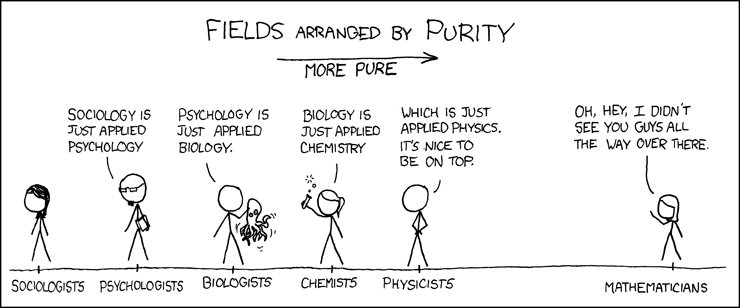
Without knowing it (or maybe he did) by posting this comic Joe was showcasing the Platonic world view (and one of the problems with it). Essentially the XKCD comic expresses the idea that the further away from reality we move, the more "ideal" or "pure" we are getting. Implicit in this argument is the assumption that in order to understand the world we must move away from all the "messy" stuff and move in the the realm of pure thought. Only then can we begin to understand anything. It is interesting to note that in seven short comments attached to that post the Platonic world view was debated, debunked and rejected in favor of the Aristotelian world view (and Clark Goble even managed to include both Heidegger's and Wittgenstein's arguments against the Platonic nature of language, impressive. And Bill, John Locke and John Stuart Mill would be proud, though many philosophers would try to lynch you for it).
So other than comics where does any of this show up? Again I need to emphasise that the basis for the Platonic world view is a fundamental distrust of reality (observation, sensations). This fundamental distrust of reality leads to all kinds of weird wacky things, like this gem that my wife came across one day. On a basic level the Platonic (or Platonic like) world view leads people to assume that in order to learn anything "real" or of value, they must disassociate themselves with reality (the physical world). This was the motivation behind the drive to use "experimental drugs", such as LSD, in order to experience things that could not be "experienced" in the physical world (this was explained to me by a philosophy student who "had friends that did drugs").
There are other implications to this but to sum up it, is enough to say that even though the Platonic and Aristotelian approaches to the world both consider the physical world to be "messy" at first, the Platonic approach feels that the "messiness" prevents the discovery of the world and thus in the ideal case we must remove the influences of all the "messy" stuff from reality, including our senses and anything that has to do with our "physical" bodies. The Aristotelian approach recognizes that the world is difficult, and while simplifications (math, equations, words, language) can be used to make it easier, the simplifications are just that, a simplification and not an ideal. Thus a Platonic approach demands that new knowledge comes from the ideal world (Plato's world of Forms), while on the other hand the Aristotelian approach assumes that knowledge comes from observation (sensation) of the physical world, and is verified again by observation. All knowledge according to the Platonic approach, by definition, is not verifiable in the Aristotelian sense, but is entirely determined by whether or not one can "think correctly" about it.
So how does this relate to the original motivation for this post involving the "conflict" between science and religion? On a fundamental level science takes an Aristotelian approach to how we learn and find out things about the universe. It asks, "What do we observe and how can we explain what we observe?" While science (and physics in particular) takes an Aristotelian approach, it is not exclusive. We still see a substantial amount of Platonic thought in science, but it is not as common as it is in other fields of research (Math is one that is substantially Platonic).
Perhaps the most prominent place Platonic thought shows up is in religion. I should emphasize that there is nothing about religion that demands Platonic thought, but at times it does seem rather conducive to Platonic thought as it mostly deals with things that are not (obviously) related to the five senses (I put the "obviously" in there because I disagree with that assertion). But if we are working under a Platonic world view then it makes sense that if one considers the mental or the abstract (the Platonic Forms) to be the most pure and perfect then that is where one would consider their God to be. This leads to the argument that God does not partake of the physical world and does not have any part in it other than being the unmoved mover (important note, there is an important distinction here between having an unmoved mover, as was Aristotle's concept, and thinking of God as the unmoved mover). In the end religion (and other "intellectual" fields, such as philosophy and math) became dominated by Platonic thought, while Aristotelian thought dominated science. Again this was not an exclusive domination (nor even correct) but that is the way it stands today in our society.
This causes problems when the question is asked, "Can you prove that God exists?" A Platonist would respond with a philosophical argument for the existence of God, an Aristotelian would respond with a demonstration of the existence of God. In the first case scientists (who are largely Aristotelian in their approach to knowledge) would reject the arguments as invalid because in order to "prove" anything according to science it must be demonstrated (mathematical proof does not count, it has to be demonstrated by experiment, see string theory). Thus the requirements for "proof" are fundamentally different for the Platonic approach and the Aristotelian approach, and because 80-90% of religion takes a Platonic approach, the tendency of scientists is to reject religion as invalid. Unfortunately this rejection first assumes that religion is fundamentally Platonic, and that any approach to it must first be Platonic (including a "scientific" approach).
This difficulty goes away if an Aristotelian approach is taken with respect to both science and religion. In other words it must be assumed that the same modes of knowing can be used for both, which depending on your views of religion (or science, or both) may be an issue. But if the same method is used for both then all apparent difficulties go away (interesting note: it works both ways, if a Platonic approach is taken in both cases then there is no conflict, but as long as a different approach is taken for either science or religion then there will be a conflict).
So now after this long explanation I will return to what I started out by saying:
On a basic level a Platonic world view carries with it a fundamental distrust of the material (observable) world. An Aristotelian world view fundamentally assumes that all knowledge comes from the observable world (universe). Note that these ideas are not opposite nor are they even mutually exclusive. But they are two approaches to the same thing, how we know and interact with the world.
The problem comes when we take the Platonic distrust of the material world to the point that we think that the material world inhibits our understanding. This is in opposition to the Aristotelian view, which is that even though the observable world may be difficult to understand it is the basis of our knowledge and our understanding and we cannot reject it as the fundamental source of knowledge.
Thursday, February 18, 2010
The "Conflict" Between Science and Religion
[Note: This is a duplicate posting of a post I just made on my other blog The Eternal Universe. If you want to comment on this post I would suggest going to The Eternal Universe and commenting there so that you can be part of the conversation. Or you can post comments here if you want.]
On a previous post Stan left a comment about the "anti-science undercurrent in our society". In a broader sense this observation of the "anti-science undercurrent" is related to what many people know as the "Conflict" between science and religion. But the very real and important questions here are, "Where did this conflict come from?" and "Does this conflict represent a fundamental disagreement between science and religion that can never be reconciled?"
In terms of the second question this is a rather important point because the implication is that if there is a fundamental disagreement between science and religion then the obvious conclusion must be that one or the other must ultimately be rejected as false. This is of course assuming that the two can never be reconciled, which is itself an assumption about the nature and relation of science and religion. But we cannot deny that there exists, at least on some level a disparity between the world views of science and religion, which results in a real, or at least a perceived, conflict between the two. Which leads us back to our first question, "Where did this conflict come from?"
A common accusation leveled against religion, and especially the Christian religion, is that it is inherently anti-scientific. While this may be sufficient for some people to prove the irrationality of Christianity, it is not a very good argument, nor does it address the issue of why it is (or perceived to be) anti-scientific. The counter argument most commonly used against this approach is to point out the inherent short-comings of science that any scientist would readily acknowledge and embrace and an integral part of science. Essentially this argument boils down to "Scientists don't know everything, so therefore there may be something you don't know about and that thing that you don't know about is the mystery of God."
These arguments can and do continue ad nauseum, but will not bring us any close to understanding the nature or the source of the conflict. So again we approach the question, "Where did this conflict come from?"
To start out let me introduce a line from an editorial piece that I read in The Daily Tar Heel. In addressing the conflict between Atheists and Theists the author offered this piece of advice to the Theists, "Theological honesty is needed. Admit that there are some aspects to Christianity that cannot be proven or even explained and must be taken on faith." (The author also had words of advice for Atheists as well, so it was not a one sided argument.) I found this line rather interesting because I felt that it is directly contrary to how I relate to my Religion. I put emphasis on my Religion, because obviously this statement must apply to someone's religion or it would never have been included in the editorial piece. But here in this statement we have potentially uncovered the root cause, or at least something that will lead us to the root cause, of the conflict between science and religion.
So let us consider this statement. First off it states that in Christianity there are things "that cannot be proven or even explained", and it is these unproven, unexplained, or even unknown, things that form the foundation of "faith". This way of thinking leads to a belief or an understanding of a God that is wholly other, unapproachable, unknowable and is outside the realm of science. Which leads directly to the conclusion that religion deals with things that cannot fall under the purview of science. With this understanding it is easy to see where this can result in conflict. If religion deals with things that are not or cannot be covered by science, then if science expands and attempts to explain the former "mysteries of God", such as creation, then those who hold to this understanding of God will naturally feel that science is impinging on "God's territory". They will view it as a kind of turf war and will view it "as if it were a threat to [their] beliefs!"
So how did we get to this point where most religious (and non-religious) people view the Christian God as having exclusive rights to, or even in the extreme case is based solely in, the realm of the Unknown, and science as pertaining to the realm of the known (and provable)?
That very important question I will leave as an exercise for the interested reader, but not to leave you with no answers (like most philosophers), so I will offer this observation by way of insight, but I will present it without proof (again an exercise for the interested reader).
In learning about this topic I have noticed that those who generally hold to the view of Christianity expressed above, where the basis of faith is something unknowable (that's unknowable as opposed to unknown), have as the basis of their world view a Platonic Philosophy. It is this group of people, both religious and non-religious alike, that consider there to be an inherent conflict between science and religion. The Platonic world view is not the exclusive domain of the non-scientific but it is a view held by the scientific an non-scientific alike. But even though the same world-view is held by both groups, different conclusions are reached, and thus results in the conflict that we know of as the conflict between science and religion.
But there is a way out of this irreconcilable debate, and again I have noticed that those who find no inherent conflict between science and religion hold to an Aristotelian world view. This means that there is a fundamental difference in the way that some people approach the world, and how they view and gain knowledge and understanding about the world. In the case of the Platonic world view there are certain assumptions about knowledge (epistemology) that affect how we view and/or know God, which results in the conflict. But the Aristotelian world view does not make the same assumptions about how we know and approach the world, and this subtle difference means that those who hold to this world view do not see an inherent conflict between science and religion.
This observation would be nothing more than an interesting philosophical footnote, if it were not for the fact that in Western societies approximately 80% of the people hold to a Platonic world view. This overwhelming majority of people that operate with the Platonic world view creates ample opportunity for conflict and for the collection of people into groups of similar beliefs and conclusions about the world. Hence you have people dividing into groups of Theists and Atheists, that perpetually seem at odds with each other. It also leads to a division of knowledge (epistemology) into the realms of the known (dominated by science, and indirectly by Atheists) and the unknowable (dominated by religion). Thus for those who hold to one side or the other, when they are presented with anything that they associate with the other side they react to it as a direct assault on their beliefs.
This makes things difficult for those of us who do not have a Platonic world view, as we are constantly finding ourselves on both sides of the debate and we are constantly asked "Which side are you on?" or "How do you reconcile you faith with what you study?" But for those who have an Aristotelian world view, or something very similar, then these types of questions make no sense and we are left confused and wondering why they are even asking those questions.
Now we can finally come to the most important question, "Now that we have this understanding, how do we share this with others so that they too can understand it and not be bogged down with the "conflict" between science and religion?" That is the hard question, and the real question that we must answer, and in a way, I think that is the purpose of The Eternal Universe.
On a previous post Stan left a comment about the "anti-science undercurrent in our society". In a broader sense this observation of the "anti-science undercurrent" is related to what many people know as the "Conflict" between science and religion. But the very real and important questions here are, "Where did this conflict come from?" and "Does this conflict represent a fundamental disagreement between science and religion that can never be reconciled?"
In terms of the second question this is a rather important point because the implication is that if there is a fundamental disagreement between science and religion then the obvious conclusion must be that one or the other must ultimately be rejected as false. This is of course assuming that the two can never be reconciled, which is itself an assumption about the nature and relation of science and religion. But we cannot deny that there exists, at least on some level a disparity between the world views of science and religion, which results in a real, or at least a perceived, conflict between the two. Which leads us back to our first question, "Where did this conflict come from?"
A common accusation leveled against religion, and especially the Christian religion, is that it is inherently anti-scientific. While this may be sufficient for some people to prove the irrationality of Christianity, it is not a very good argument, nor does it address the issue of why it is (or perceived to be) anti-scientific. The counter argument most commonly used against this approach is to point out the inherent short-comings of science that any scientist would readily acknowledge and embrace and an integral part of science. Essentially this argument boils down to "Scientists don't know everything, so therefore there may be something you don't know about and that thing that you don't know about is the mystery of God."
These arguments can and do continue ad nauseum, but will not bring us any close to understanding the nature or the source of the conflict. So again we approach the question, "Where did this conflict come from?"
To start out let me introduce a line from an editorial piece that I read in The Daily Tar Heel. In addressing the conflict between Atheists and Theists the author offered this piece of advice to the Theists, "Theological honesty is needed. Admit that there are some aspects to Christianity that cannot be proven or even explained and must be taken on faith." (The author also had words of advice for Atheists as well, so it was not a one sided argument.) I found this line rather interesting because I felt that it is directly contrary to how I relate to my Religion. I put emphasis on my Religion, because obviously this statement must apply to someone's religion or it would never have been included in the editorial piece. But here in this statement we have potentially uncovered the root cause, or at least something that will lead us to the root cause, of the conflict between science and religion.
So let us consider this statement. First off it states that in Christianity there are things "that cannot be proven or even explained", and it is these unproven, unexplained, or even unknown, things that form the foundation of "faith". This way of thinking leads to a belief or an understanding of a God that is wholly other, unapproachable, unknowable and is outside the realm of science. Which leads directly to the conclusion that religion deals with things that cannot fall under the purview of science. With this understanding it is easy to see where this can result in conflict. If religion deals with things that are not or cannot be covered by science, then if science expands and attempts to explain the former "mysteries of God", such as creation, then those who hold to this understanding of God will naturally feel that science is impinging on "God's territory". They will view it as a kind of turf war and will view it "as if it were a threat to [their] beliefs!"
So how did we get to this point where most religious (and non-religious) people view the Christian God as having exclusive rights to, or even in the extreme case is based solely in, the realm of the Unknown, and science as pertaining to the realm of the known (and provable)?
That very important question I will leave as an exercise for the interested reader, but not to leave you with no answers (like most philosophers), so I will offer this observation by way of insight, but I will present it without proof (again an exercise for the interested reader).
In learning about this topic I have noticed that those who generally hold to the view of Christianity expressed above, where the basis of faith is something unknowable (that's unknowable as opposed to unknown), have as the basis of their world view a Platonic Philosophy. It is this group of people, both religious and non-religious alike, that consider there to be an inherent conflict between science and religion. The Platonic world view is not the exclusive domain of the non-scientific but it is a view held by the scientific an non-scientific alike. But even though the same world-view is held by both groups, different conclusions are reached, and thus results in the conflict that we know of as the conflict between science and religion.
But there is a way out of this irreconcilable debate, and again I have noticed that those who find no inherent conflict between science and religion hold to an Aristotelian world view. This means that there is a fundamental difference in the way that some people approach the world, and how they view and gain knowledge and understanding about the world. In the case of the Platonic world view there are certain assumptions about knowledge (epistemology) that affect how we view and/or know God, which results in the conflict. But the Aristotelian world view does not make the same assumptions about how we know and approach the world, and this subtle difference means that those who hold to this world view do not see an inherent conflict between science and religion.
This observation would be nothing more than an interesting philosophical footnote, if it were not for the fact that in Western societies approximately 80% of the people hold to a Platonic world view. This overwhelming majority of people that operate with the Platonic world view creates ample opportunity for conflict and for the collection of people into groups of similar beliefs and conclusions about the world. Hence you have people dividing into groups of Theists and Atheists, that perpetually seem at odds with each other. It also leads to a division of knowledge (epistemology) into the realms of the known (dominated by science, and indirectly by Atheists) and the unknowable (dominated by religion). Thus for those who hold to one side or the other, when they are presented with anything that they associate with the other side they react to it as a direct assault on their beliefs.
This makes things difficult for those of us who do not have a Platonic world view, as we are constantly finding ourselves on both sides of the debate and we are constantly asked "Which side are you on?" or "How do you reconcile you faith with what you study?" But for those who have an Aristotelian world view, or something very similar, then these types of questions make no sense and we are left confused and wondering why they are even asking those questions.
Now we can finally come to the most important question, "Now that we have this understanding, how do we share this with others so that they too can understand it and not be bogged down with the "conflict" between science and religion?" That is the hard question, and the real question that we must answer, and in a way, I think that is the purpose of The Eternal Universe.
Subscribe to:
Posts (Atom)